2026-09-10 ワシントン大学(UW)
<関連情報>
- https://www.washington.edu/news/2026/09/10/coyote-density-is-9-times-higher-in-seattle-than-in-washingtons-wild-lands/
- https://iopscience.iop.org/article/10.1088/2752-664X/ae9ffd
都市化によりワシントン州ではコヨーテの生息密度が9倍に増加したが、シアトル市内では人間の密集による悪影響もみられる Urbanization increases coyote density 9-fold in Washington state despite negative effects of human density within Seattle, USA
Laura R Prugh, Prashant Mahajan, Ellen Reese, Samantha E S Kreling, Iona M Rohan, Rebecca M Windell and Yasmine Hentati
Environmental Research: Ecology Published: 10 September 2026
DOI:10.1088/2752-664X/ae9ffd
Abstract
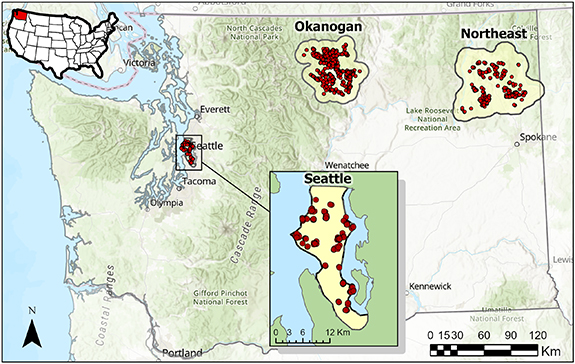
The coyote (Canis latrans) is a highly adaptable and ecologically important mesocarnivore that has colonized nearly every major metropolitan area in North America over the past century. While the urban environment appears highly amenable to coyotes, quantitative estimates of how urbanization affects their densities are scarce. We genotyped 842 scats from 261 individual coyotes in Seattle, Washington USA and two wildland areas of the state, and we used spatial capture-recapture models to estimate population density in each area. We found that coyote density in Seattle was 9.3 times higher than in wildlands (0.38 versus 0.041 coyotes per km2, respectively). To understand factors affecting coyote density in Seattle, we evaluated the influence of societal and environmental covariates. These models revealed a strong negative association between human density and coyote density, whereas effects of impervious surface, tree cover, pollution burden, and median household income did not have significant effects. These findings indicate that human impacts on coyote density are likely scale-dependent, with positive effects across broad urban-wildland gradients but negative effects within cities. Relaxed top-down control by humans and large carnivores combined with abundant resources make cities ideal habitat for coyotes, capable of supporting densities that far exceed those found in wildlands.