2026-10-16 中国科学院(CAS)
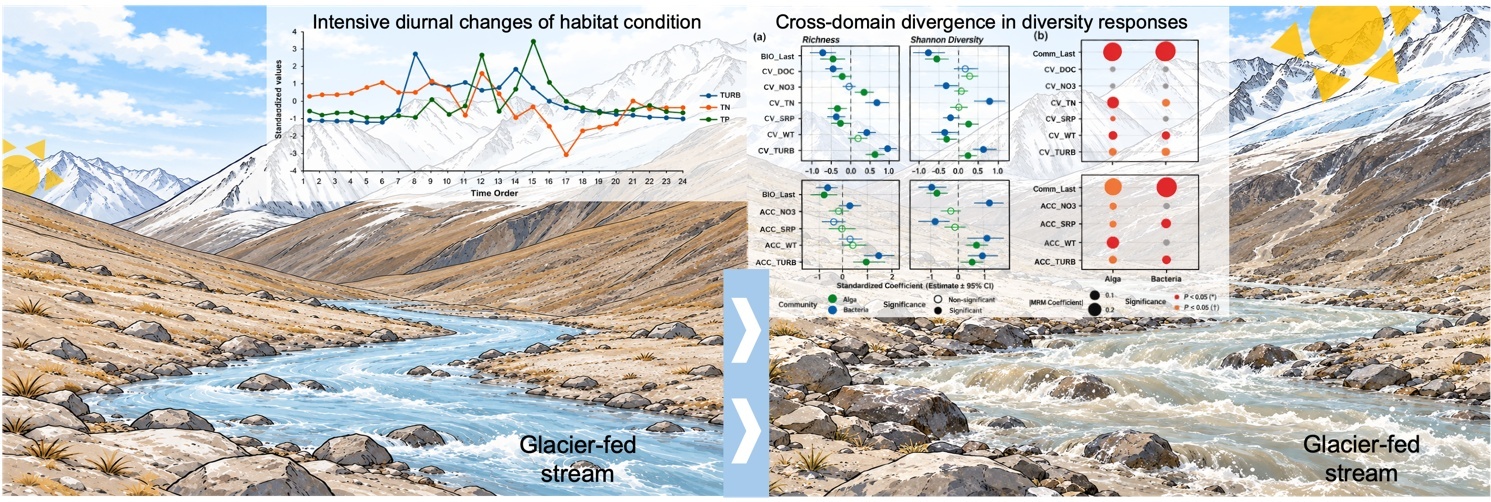
The intensive diurnal changes of habitat conditions in the glacier-fed stream and the divergent cross-domain diversity responses of the epilithic biofilm community. (Image by IHB)
<関連情報>
- https://english.cas.cn/newsroom/research-news/202610/t20261016_1205517.shtml
- https://www.sciencedirect.com/science/article/abs/pii/S0013935126021274?via%3Dihub
氷河を水源とする河川における環境変動に対するバイオフィルム多様性応答のドメイン間差異 Cross-domain divergence in biofilm diversity responses to environmental variability in a glacier-fed stream
Biao Wang, Hui Wang, Jia Jia, Xin Li, Hongjuan Hu, Xiong Xiong, Chenxi Wu
Environmental Research Available online 28 September 2026
DOI:https://doi.org/10.1016/j.envres.2026.125796
Highlights
- Glacier-fed stream biofilms showed divergent bacterial and algal diversity responses.
- Bacteria showed stronger temporal patterns, whereas algae showed spatial structure.
- Turbidity positively influenced alpha diversity across bacterial and algal communities.
- Cumulative and variability of environmental conditions regulated diversity at different scales.
- Hydrurus shaped algal diversity patterns within glacier-fed stream biofilms.
Abstract
A central question in community ecology is how environmental variability shapes the diversity and temporal organization of co-occurring organisms. In glacier-fed stream biofilms, bacteria and eukaryotic algae occupy the same physical matrix but may not respond synchronously to environmental change, yet cross-domain responses under highly variable cryospheric conditions remain poorly understood. We combined melt-season biofilm sampling at three sites from May-September 2023 in a glacier-fed stream with 504 hourly stream-water measurements collected during 12-h daytime windows. Bacterial and eukaryotic algal assemblages were characterized using 16S and 18S rRNA amplicon sequencing, and linear mixed-effects models and multiple regression on distance matrices were used to relate alpha and beta diversity to sub-daily cumulative environmental conditions, sub-daily variability, lagged community states, and the relative abundance of the dominant alga Hydrurus. Bacterial composition showed stronger temporal than spatial variation, whereas the complete algal assemblage exhibited stronger spatial structuring; after excluding Hydrurus, algal communities also showed a stronger temporal signal. Turbidity was consistently associated with alpha diversity across both domains, whereas temperature and nutrient associations differed between bacteria and algae and between environmental time dimensions. Lagged community dissimilarity showed the strongest association with beta diversity across models, indicating pronounced temporal dependence in community composition. Hydrurus abundance improved selected alpha-diversity models and explained algal-subcommunity turnover only under sub-daily variability. Together, these findings demonstrate that co-occurring bacterial and algal assemblages within the same biofilm can exhibit contrasting spatial, temporal, and environmental associations, and that microbial responses to environmental variability cannot be inferred from a single biological group. The distinct behavior of Hydrurus-dominated algal assemblages further suggests that this mat-forming alga may modify the physical structure and microenvironment of biofilms, thereby influencing bacterial and algal coexistence and community turnover, which needs further investigation.