2026-09-02 北海道大学,科学技術振興機構
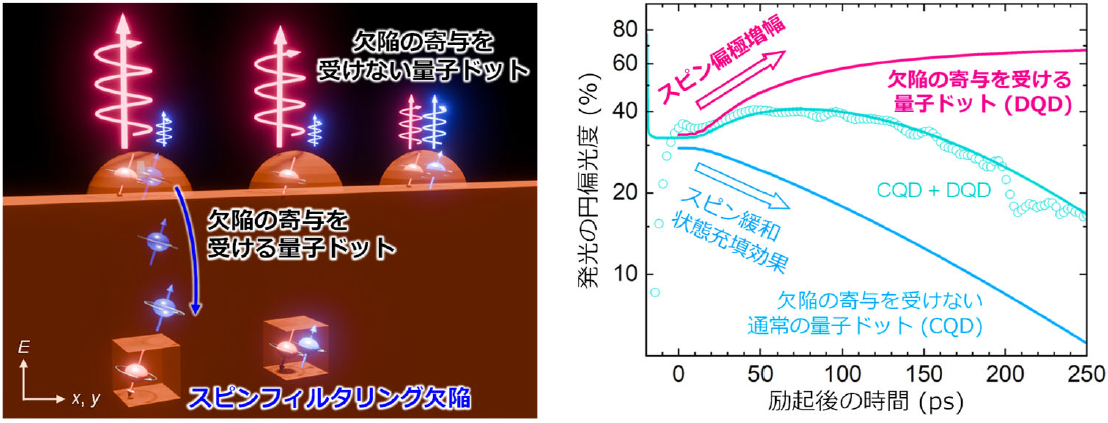
開発したスピンフィルタリング欠陥を持つ半導体ナノ材料の模式図と今回の研究成果
<関連情報>
- https://www.hokudai.ac.jp/news/2026/09/–14.html
- https://advanced.onlinelibrary.wiley.com/doi/10.1002/adom.71622
欠陥を利用したスピンフィルタリング機能を統合した高スピン偏極発光量子ナノ材料 Highly Spin-Polarized Luminescent Quantum Nanomaterials Integrated with a Defect-Enabled Spin-Filtering Function
Ayano Morita, Mattias Jansson, Junichi Takayama, Irina A. Buyanova, Weimin M. Chen, Akihiro Murayama, Satoshi Hiura
Advanced Optical Materials Published: 01 September 2026
DOI:https://doi.org/10.1002/adom.71622
ABSTRACT
Highly spin-polarized luminescence at room temperature is essential for active layers in practical opto-spintronic devices. Although this has been achieved in existing studies, a spatial separation of electrons and holes occurs, which typically reduces radiative recombination efficiency. As such, incorporating a defect-enabled spin-filtering function into semiconductor quantum dots (QDs) with 3D quantum confinement is necessary. This study introduces spin-filtering defects and primarily investigates the electron spin dynamics in dilute nitride InGaAsN QDs using time-resolved circularly polarized photoluminescence. InGaAsN QDs exhibit suppressed electron thermal escape and a wide tunability of the emission wavelength through nitrogen incorporation. However, their potential for opto-spintronic applications has not yet been explored. Here, the QDs integrated with a spin-filtering function are found to coexist with conventional QDs. The circularly polarized luminescence properties of the novel QDs are extracted via rate equation analysis, considering spin-dependent electron capture by the defect states. The QDs exhibit a high circular polarization exceeding 50% at room temperature (295 K) owing to the suppressed state-filling effect and the selective capture of minority spins from the QD emissive to defect states. These findings pave the way for developing practical opto-spintronics nanomaterials that combine high luminescence intensity with highly spin-polarized luminescence.