2026-08-31 東京理科大学
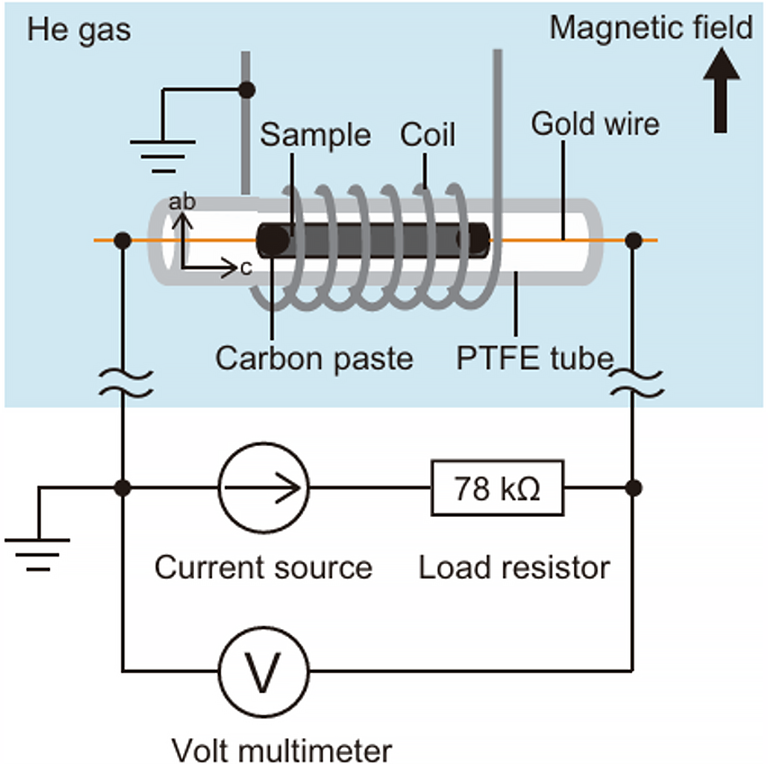
図1 バルク結晶の¹H-NMR測定の模式図。
<関連情報>
- https://www.tus.ac.jp/today/archive/20260831_0131.html
- https://journals.aps.org/prapplied/abstract/10.1103/3yjz-8f9d
金属-絶縁体転移が急激なバルク有機導体における揮発性抵抗スイッチング状態 Volatile resistive-switched state in a bulk organic conductor with a sharp metal-insulator transition
Riku Ishii, Ryo Motohashi, Keitaro Tada, Yusuke Suzuki, Takayoshi Kouchi, Hiroshi Oike, Fumitaka Kagawa, Reizo Kato, and Tetsuaki Itou
Physical Review Applied Published: 17 August, 2026
DOI: https://doi.org/10.1103/3yjz-8f9d
Abstract
Volatile resistive switching in correlated-electron systems, characterized by an abrupt resistance decrease under applied current, is crucial for developing next-generation electronics. Despite its technological significance, the underlying physics remains elusive. Inorganic thin films on substrates—the widely studied platform for resistive switching—usually exhibit broad temperature-induced metal-insulator transitions (MITs) and substantial heat dissipation. These factors complicate the nonlinear thermal effect induced by Joule heating, a key contributor to resistive switching, rendering it excessively complex and difficult to decipher. Here, we investigate a resistive-switched state in the bulk organic conductor (7−DMe−DCNQI)2Cu, which undergoes an extremely sharp first-order MIT and exhibits weak heat dissipation, using resistance and 1H−NMR measurements. These extreme conditions make the Joule heating effect vivid, allowing us to observe peculiar phenomena, including temperature locking to the MIT and “inverse Ohm’s law”—an inverse proportionality between voltage and current. These findings provide fundamental insights into the nonlinear thermal effect in resistive switching, offering a pathway to efficient resistive switching technologies.