2026-08-27 国立環境研究所,森林総合研究所,北海道大学
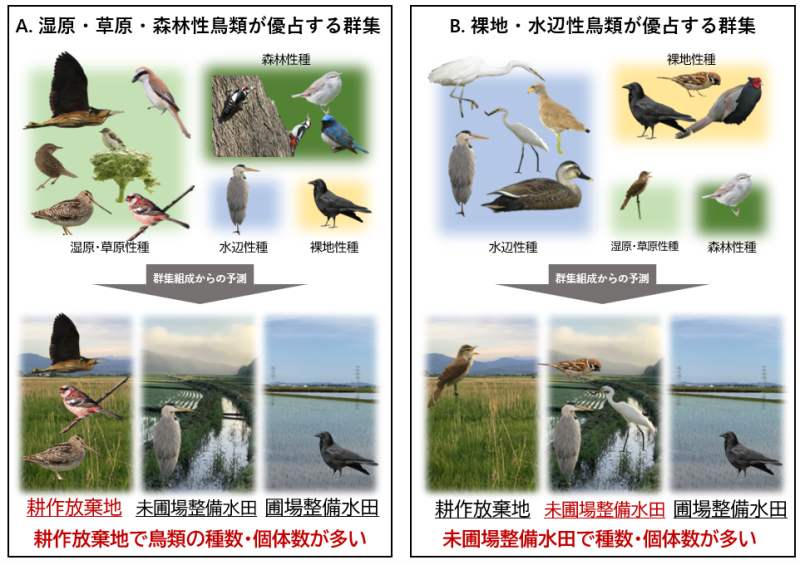
図1. 本研究で提案した概念モデル
<関連情報>
- https://www.nies.go.jp/pr/news-and-updates/2026/Press20260827.html
- https://www.pnas.org/doi/10.1073/pnas.2530120123
優勢な機能グループが、農地放棄に対する世界的な鳥類の多様性の反応を説明する Dominant functional group explains global bird diversity responses to farmland abandonment
Munehiro Kitazawa, Yuichi Yamaura, Kazuhiro Kawamura, +1 , and Futoshi Nakamura
Proceedings of the National Academy of Sciences Published:July 27, 2026
DOI:https://doi.org/10.1073/pnas.2530120123
Abstract
Reversing biodiversity declines will require redesigning agricultural landscapes and their management. Farmland abandonment and intensification are emerging as major drivers of biodiversity changes, and their consequences vary widely from negative to positive among continents. Despite decades of research on agricultural biodiversity, no generalizable framework has been established to predict these variations globally, hindering the development of effective conservation strategies. Here, we combine broad-scale, multiseason avian field surveys across Japan with a global meta-analysis spanning four continents. In field surveys, we compared avian species richness among 2-ha plots in abandoned farmland (≤ 50 y since abandonment), traditional farmland, and intensive farmland, controlling for the surrounding land-use cover. We showed that the dominant functional group robustly explains the direction and strength of community-level responses to abandonment and intensification. When mature-habitat species comprise over 50% of communities, abandonment enhances species richness by over 240%, reaching levels comparable to natural wetlands. Abandoned farmlands hold the potential to offset past biodiversity declines and thus merit considerations for inclusion within the conservation area networks. Conversely, when disturbed-habitat species comprise more than 48% of communities, abandonment and intensification reduce species richness, underscoring the importance of biodiversity-friendly farming. This study provides a basis to understand how to address varied spatial variations in biodiversity responses to management and land-cover changes—a long-standing hurdle in conservation science. Complex bird diversity responses can be predicted globally by simply identifying the dominant functional group, thereby helping develop the most effective conservation strategies. Transferability beyond birds and across taxa should be evaluated empirically.