2026-08-26 東北大学
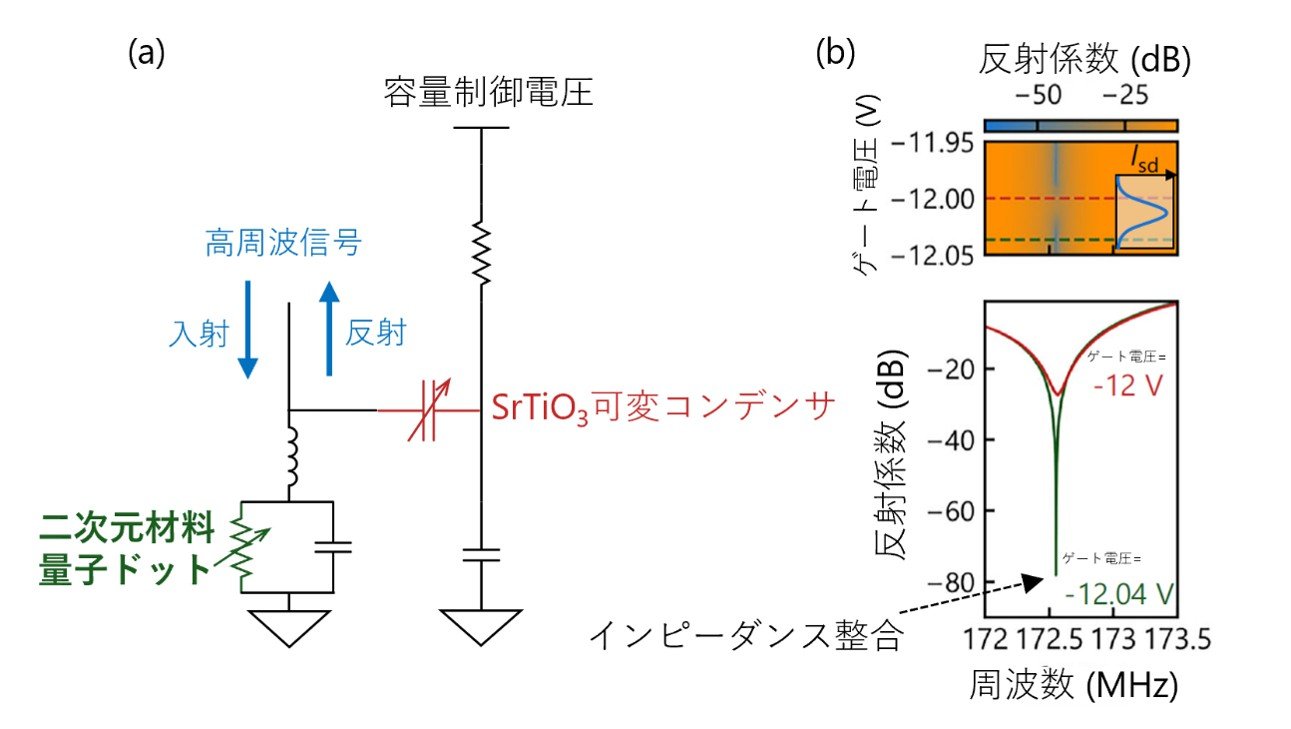
図1. (a) 本研究で用いた測定回路の概略図。 (b) 可変コンデンサを最適化し、量子デバイスのゲート電圧を変化させながら測定した高周波反射特性。
<関連情報>
- https://www.tohoku.ac.jp/japanese/2026/08/press20260826-03-dot.html
- https://www.nature.com/articles/s41699-026-00730-0
完全インピーダンス整合が切り拓く二次元材料量子ドットにおける高感度高周波反射測定 Perfect impedance matching unlocks sensitive radio-frequency reflectometry in 2D material quantum dots
Motoya Shinozaki,Akitomi Shirachi,Yuta Kera,Tomoya Johmen,Shunsuke Yashima,Aruto Hosaka,Tsuyoshi Yoshida,Takeshi Kumasaka,Yusuke Kozuka & Tomohiro Otsuka
npj 2D Materials and Applications Published:20 August 2026
DOI:https://doi.org/10.1038/s41699-026-00730-0 Early provide
Abstract
Two-dimensional (2D) materials are attractive platforms for realizing high-performance quantum bits (qubits). However, radio-frequency (RF) charge detection, which is a key technique for qubits readout, remains challenging in such systems. We demonstrate RF reflectometry with impedance matching for high-resistance quantum dot devices based on bilayer graphene and molybdenum disulfide. By integrating a tunable strontium titanate (SrTiO3) varactor into a resonant circuit, we achieve nearly perfect impedance matching, enabling sensitive charge detection. The demodulated RF signal clearly shows Coulomb oscillations, and the SrTiO3 varactor exhibits robustness against both magnetic fields and voltage noise on the varactor. Our results establish SrTiO3 varactors as effective tunable matching components for RF reflectometry in high-resistance 2D material quantum devices, providing a foundation for high-speed qubits readout.