2026-08-13 清華大学
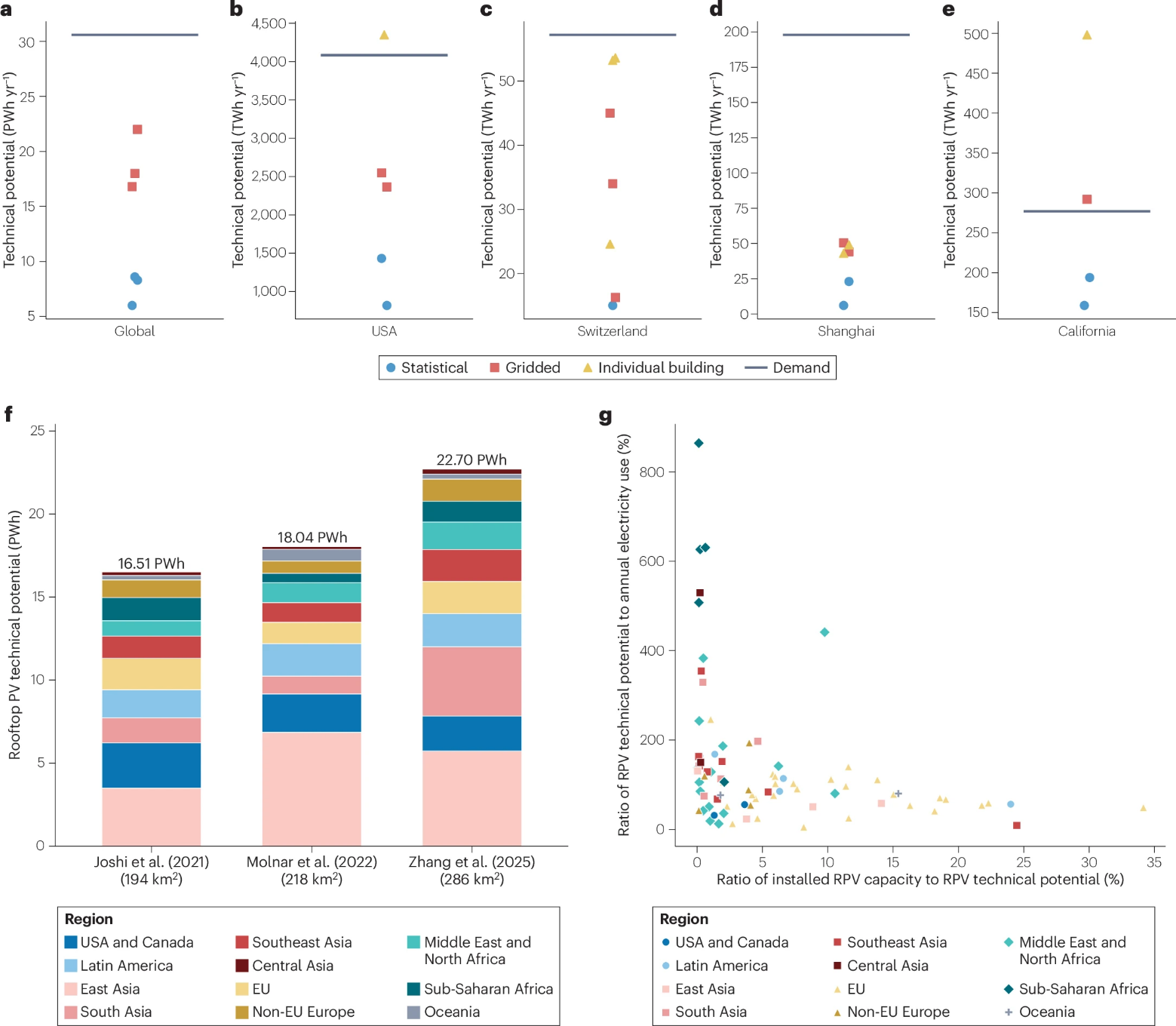
Fig. 1: Estimates of global and regional rooftop solar photovoltaic (RPV) technical potential.
<関連情報>
- https://www.tsinghua.edu.cn/en/info/1245/15014.htm
- https://www.nature.com/articles/s44359-026-00179-w
屋上太陽光発電の技術的可能性から実用化の可能性まで Technical to deployable potential of rooftop solar photovoltaics
Mai Shi,Haochi Wu,Zhecheng Wang,Ziwen Ruan,Aviad Navon,Renzhi Jing,Xinjie Li,Chaojun Li,Xi Lu,Jinyue Yan,Wei Chen,Xiaohua Liu,Xiaochen Liu,Yi Jiang,Kebin He & Michael T. Craig
Nature Reviews Clean Technology Published:17 June 2026
DOI:https://doi.org/10.1038/s44359-026-00179-w
Abstract
Rooftop solar photovoltaics are important in generating electricity from renewable sources, yet estimates of its potential vary widely because of inconsistent definitions and measurements. Moreover, assessments often focus on technical potential and do not consider economic potential and deployable potential, which exhibit even greater heterogeneity in estimates. This Review examines estimates of how much electricity rooftop solar can generate and how much of that potential is achievable. Methods for mapping technical potential vary from statistics-based approaches to building-based and gridded machine learning methods. These approaches and their data sources, resolution and methodological decisions shape headline estimates. As a result, assessments of rooftop solar technical potential, or power generation potential on all physically available rooftops, yield highly divergent values owing to the evolution of methodologies and building stocks. Subsets of technical potential, such as economic and deployable potential, reduce estimates of rooftop solar potential by accounting for power system, socioeconomic, reliability and competitive barriers. New technologies, business models and operations narrow the gap between technical and realizable potential. Additional work to integrate different definitions of potential and address these barriers is needed to more accurately assess and unlock rooftop solar as a scalable, reliable power source of the clean energy transition.