2026-08-24 東京科学大学
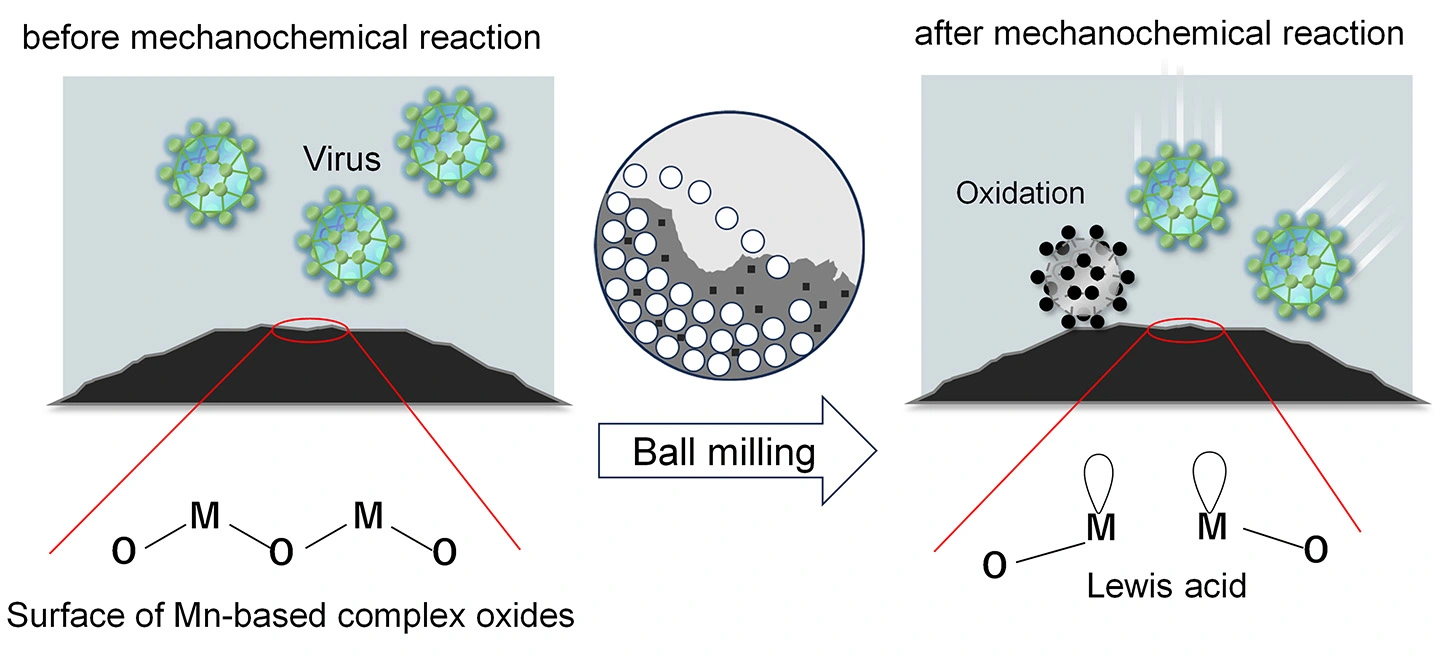
図1. 本研究のイメージ。メカノケミカル処理を行わない状態(左図)ではウイルスはMn系複合酸化物表面に固定化されず、不活化されにくい。メカノケミカル処理後(右図)ではルイス酸点にウイルスが固定化され、不活化されやすくなる。
<関連情報>
- https://www.isct.ac.jp/ja/news/jwurlwldynm0
- https://pubs.rsc.org/mr/article/doi/10.1039/d6mr00020g/1281039/Mechanochemical-activation-of-Mn-based-complex
ボールミル法によるマンガン系複合酸化物のメカノケミカル活性化による、エンベロープウイルスに対する抗ウイルス活性の向上
Mechanochemical activation of Mn-based complex oxides by ball milling for enhanced antiviral activity against enveloped viruses
Kotaro Miyazaki;Yasuhide Mochizuki;Toshihiro Isobe;Satoshi Ishikawa;Keiichi Kobayashi;Takeshi Nagai;Hitoshi Ishiguro;Akira Nakajima
RSC Mechanochemistry Published:16 July 2026
DOI:https://doi.org/10.1039/d6mr00020g
In order to prepare new inorganic materials with high antiviral activity, various Mn-based composite oxides were ball milled in ethanol and their effects were investigated. Powders of ZnMn2O4, CuMn2O4, YMnO3, and BiMn2O5 were synthesized as nearly single phases by solid-state mixing or coprecipitation methods. These samples were subsequently subjected to ball milling in ethanol. For all samples, ball milling led to an enhanced degradation rate of 2-naphthol in water. Surface charge measurements revealed that ball milling induced a change in the surface charge of ZnMn2O4 and CuMn2O4 from negative to positive. This fact is attributed to an increase in Lewis acid sites associated with oxygen vacancies introduced by the milling process. The antiviral activity of the prepared samples against the enveloped bacteriophage Φ6, used as a model enveloped virus, was evaluated under dark conditions. For all materials, the milled samples exhibited higher antiviral activity than the corresponding unmilled samples, with CuMn2O4_milled showing the highest antiviral performance. Detailed analysis suggests that the antiviral mechanism involves an anchoring effect of viruses onto the sample surface via Lewis acid sites, as well as distortion and degradation of viral surface lipids and proteins induced by eluted ions and the Mars–van Krevelen mechanism. Furthermore, it was revealed that the formation of surface ethoxy groups during the milling process also contributes in the case of CuMn2O4. The formation of surface ethoxy groups is characteristic of Cu-based systems. These results demonstrate that mechanochemical treatment by ball milling in ethanol is an effective strategy for enhancing the antiviral activity of Mn-based complex oxides.