2026-08-24 ミュンヘン大学(LMU)
<関連情報>
- https://www.lmu.de/en/newsroom/news-overview/news/transparency-for-global-health-aid-7efa086c.html
- https://www.nature.com/articles/s41467-026-76542-z
機械学習を用いて世界の保健援助における資金格差を追跡する Tracking funding disparities in global health aid with machine learning
Finn Stürenburg,Kerstin Forster,Nicolas Banholzer,Malte Toetzke,Kenneth Harttgen &Stefan Feuerriegel
Nature Communications Published:18 August 2026
DOI:https://doi.org/10.1038/s41467-026-76542-z
Abstract
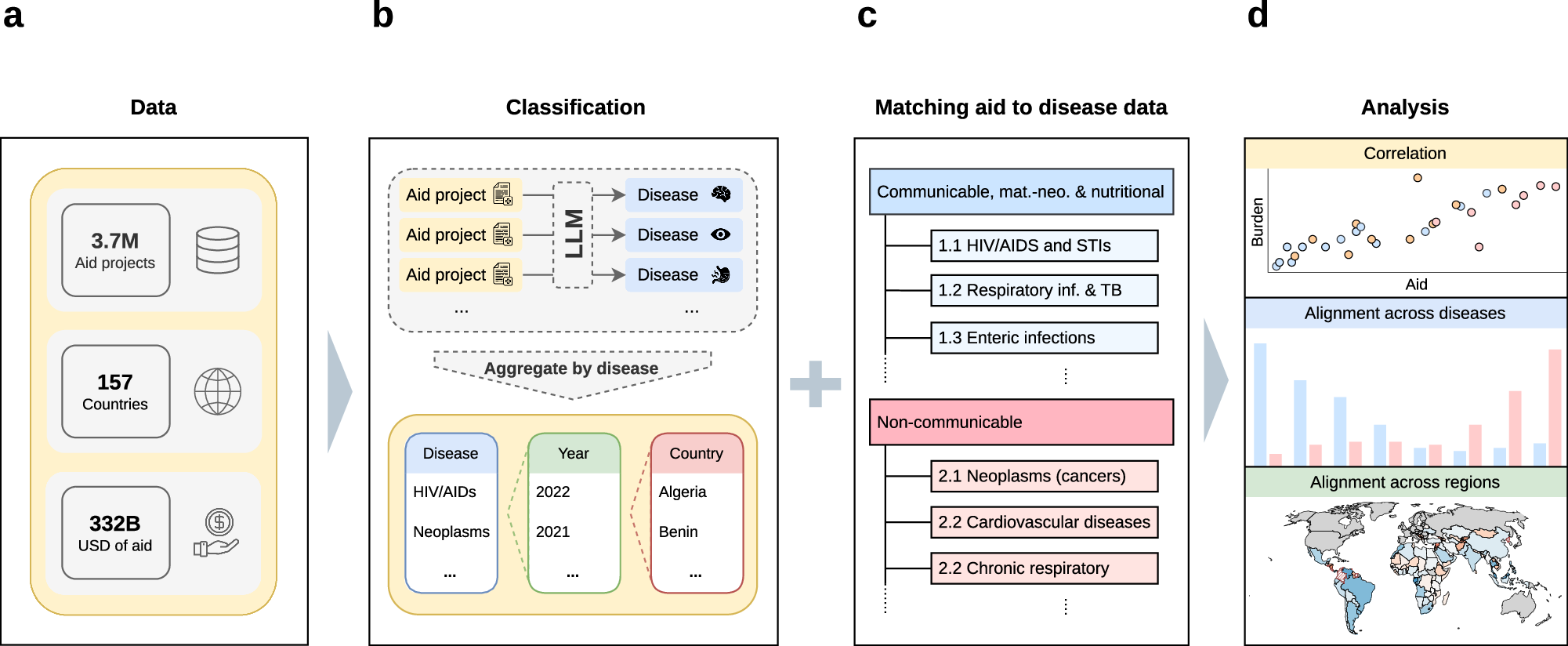
Reducing the global burden of disease is crucial for improving health outcomes. However, misalignment between health aid and country-level disease burden leaves vulnerable populations without the necessary support for major health challenges, particularly in the least developed countries. Here, we develop a machine learning pipeline using large language models to track flows in official development assistance (ODA) earmarked for health and identify aid–burden misalignment. We classified 3.7 million development aid projects from 2000 to 2022 (USD ~ 332 billion) into 17 major categories of communicable, maternal, neonatal, and nutritional diseases (CMNNDs) and non-communicable diseases (NCDs). We compared the rank of per capita ODA disbursement against the rank of disease burden, measured in disability-adjusted life years (DALYs). We interpret DALY-based alignment as a policy-relevant heuristic rather than a prescriptive allocation criterion. Although funding and disease burden are significantly correlated for many diseases, there are notable disparities. For example, NCDs account for 59.5% of global DALYs but received only 2.5% of health-related ODA over the study period. This is concerning because low- and middle-income countries face an increasing double burden from both CMNNDs and NCDs. Our results show aid–burden misalignment across multiple diseases in several regions, including Central Africa and parts of South Asia and West Africa. Overall, our results identify health disparities to potentially inform policy decisions on development assistance and support targeted allocation of health aid.