2026-08-13 東京科学大学
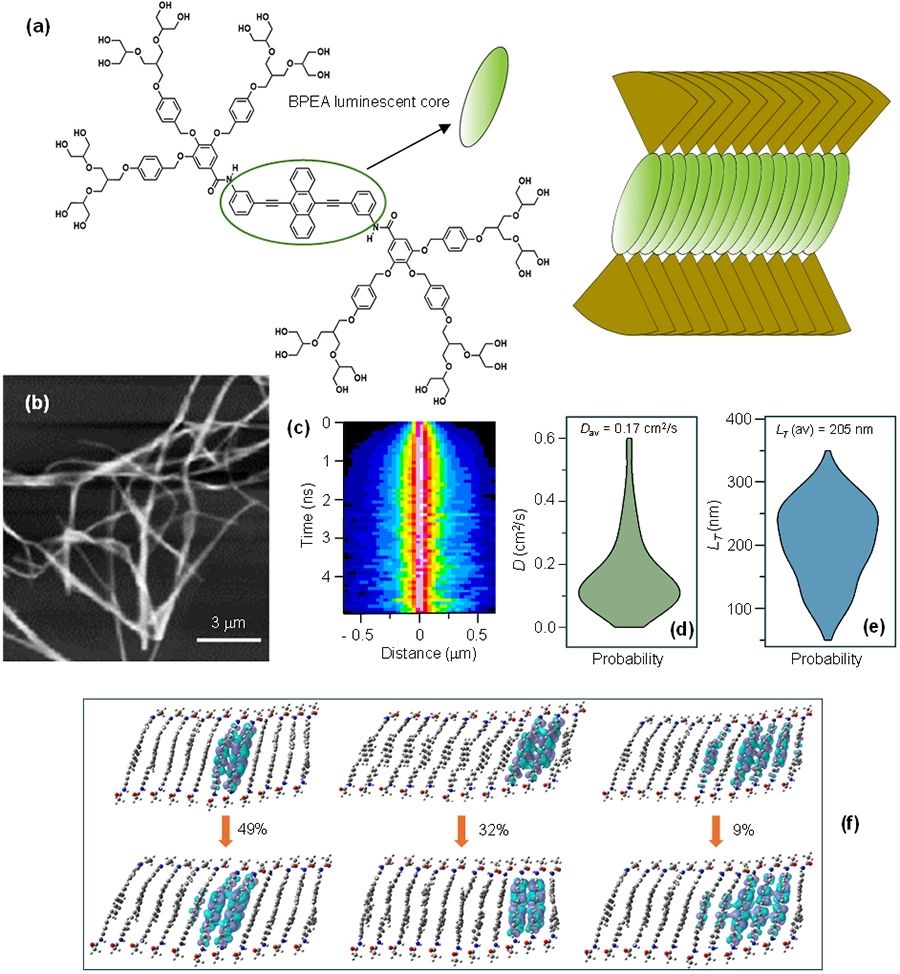
図1. (a)BPEAコアを持つモノマー化学構造と超分子ナノファイバーの構造
(b)超分子ナノファイバーの蛍光顕微鏡イメージ
(c)ナノファイバーの1か所で得られた蛍光寿命対位置の2次元プロット
(d)励起子拡散係数Dの分布
(e)励起子輸送長LTの分布
(f)最も強い遷移について自然遷移軌道対を用いた励起状態の可視化
<関連情報>
- https://www.isct.ac.jp/ja/news/ksjr3rrusvuy
- https://pubs.acs.org/nalefd/article/26/28/9303/5204543/Long-Range-Exciton-Transport-in-Anthracene-Based
アントラセン系超分子メソ構造における長距離励起子輸送とその表面プラズモンによる制御 Long-Range Exciton Transport in Anthracene-Based Supramolecular Mesostructures and Its Control by Surface Plasmons
Nithin Pathoor;Qiwen Tan;Wenhao Zhang;Misa Nozaki;Takatoshi Fujita;Toranosuke Takagi;Shun Omagari;Yoshimitsu Sagara;Martin Vacha
Nano Letters Published:July 09, 2026
DOI:https://doi.org/10.1021/acs.nanolett.6c02411
Abstract
Efficient singlet exciton transport is essential for optoelectronic applications, but in organic solids exciton diffusion is limited to tens of nanometers. We study exciton transport in supramolecular nanofibers self-assembled from 9,10-bis(phenylethynyl)anthracene (BPEA) derivatives end-capped with hydrophilic dendritic structures. Hydrogen bonds determine the nanofiber structure and induce J-aggregate character of the BPEA chromophores. Position-dependent fluorescence lifetime reveals exciton diffusion lengths up to 350 nm and diffusion coefficients up to 0.7 cm2/s, among the highest reported for organic solids. Quantum-chemical calculations combined with exciton diffusion simulations qualitatively reproduce the spectral properties and diffusion behavior. Structural rigidity, exciton delocalization over 2–3 monomers, and mixing of the locally excited and charge-transfer states are proposed as factors enabling the long-range transport. Additionally, plasmonic nanohole gold substrates enhance exciton transport by more than 2-fold, with a nanofiber orientation revealing the role of local electric field in the plasmonic enhancement of the Förster-type exciton transport.