2026-08-10 カリフォルニア大学リバーサイド校(UCR)
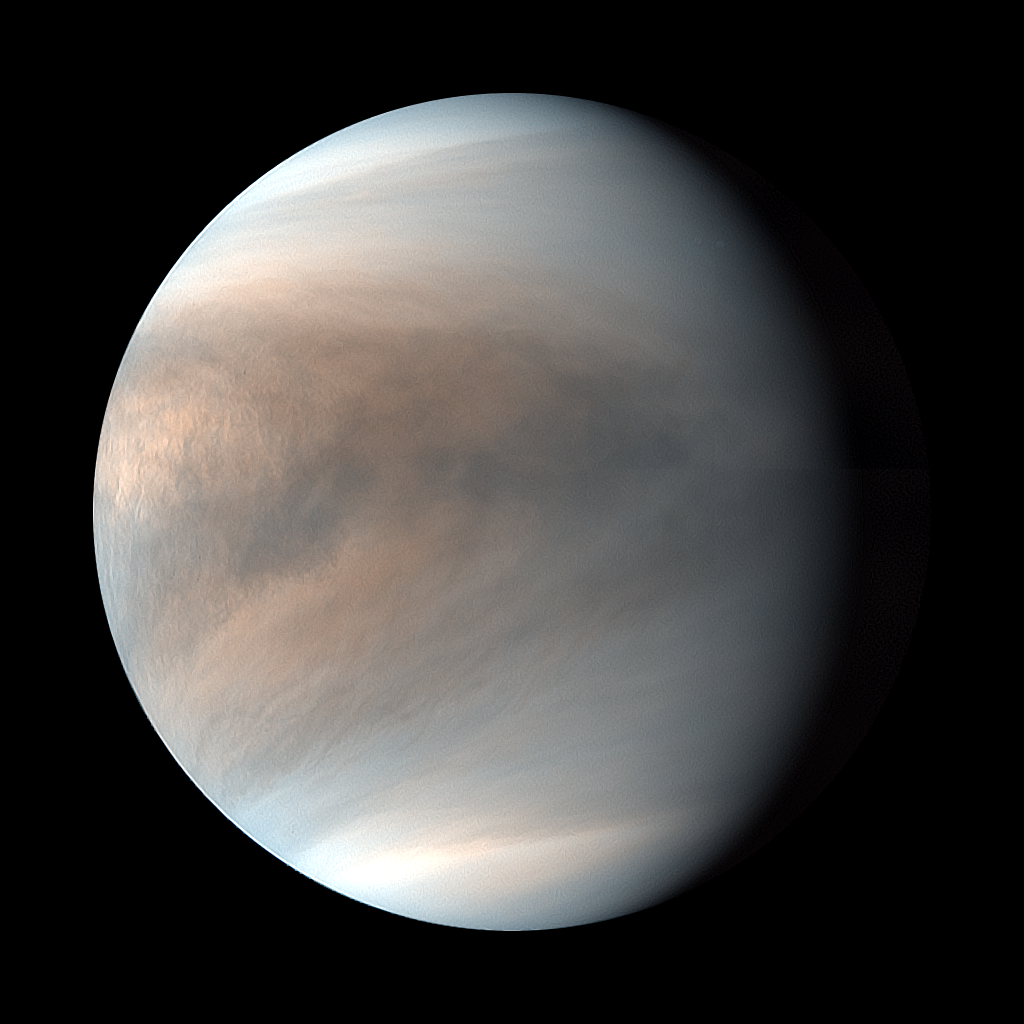
Image of Venus captured by the Japanese Akatsuki mission. (JAXA)
<関連情報>
- https://news.ucr.edu/articles/2026/08/10/slow-spin-could-explain-why-planets-become-hellish
- https://arxiv.org/abs/2608.06475
- https://iopscience.iop.org/article/10.1088/1538-3873/ae8b2a
金星系外惑星の誤ったスピン The False Spin of an Exo-Venus
Stephen R. Kane
arXiv Submitted on 6 Aug 2026
DOI:https://doi.org/10.48550/arXiv.2608.06475
Abstract
Direct imaging of terrestrial exoplanets will enable rotational and atmospheric characterization through time-resolved photometry and high-dispersion spectroscopy. However, the velocity field inferred from reflected light does not necessarily correspond to the rotation of the solid planet, but rather to the motion of the layer from which the photons emerge. Venus provides a crucial Solar System example of this ambiguity: the solid planet rotates slowly, whereas the cloud-level atmosphere exhibits superrotation with a period of only several days. Here we investigate the observational degeneracy between rapid planetary rotation and atmospheric superrotation. We construct a disk-integrated reflected-light velocity model that includes solid-body rotation, zonal winds, and phase-dependent illumination. We show that, for a single spectral tracer probing a narrow range of pressures, a zonal wind field whose latitude dependence is similar to solid-body rotation can exactly mimic the line profile of a rapidly rotating planet. The degeneracy can be broken by measuring the apparent rotational velocity as a function of wavelength or line formation pressure. For a Venus-like wind profile, the apparent period can vary from hundreds of days in the lower atmosphere to ∼4–5~days at the cloud deck. We estimate the resolving power and signal-to-noise ratio required to measure this vertical shear. The most robust diagnostic of atmospheric superrotation is not a single value of vsini, but an altitude-dependent “false spin” signature across multiple spectral tracers. These results have direct implications for interpreting rotational measurements of Venus-like worlds with the Habitable Worlds Observatory and complementary high-dispersion facilities.
PLATOによる金星帯の地球型惑星の予想産出量 The Expected Yield of Venus Zone Terrestrial Planets from PLATO
Stephen R. Kane, Emma L. Miles, Colby M. Ostberg, Erika Kohler, and James B. Garvin
Publications of the Astronomical Society of the Pacific Published: 2026 July 30
DOI:10.1088/1538-3873/ae8b2a
Abstract
The characterization of terrestrial exoplanets and the conditions that lead to divergent climate outcomes is a primary goal of exoplanetary science. The Venus Zone (VZ) provides a framework for identifying planets that may have experienced runaway greenhouse processes similar to Venus, and the statistical properties of such planets bear directly on models of planetary habitability. Here we present a quantitative estimate of the expected yield of VZ terrestrial planets from ESA’s PLAnetary Transits and Oscillations of stars (PLATO) mission. We combine the predicted PLATO planet yield for Earth-size (0.8–1.25 R⊕) and super-Earth (1.25–2.0 R⊕) planets with empirical occurrence rates for VZ terrestrial planets derived from Kepler data. Under conservative assumptions, we estimate that PLATO will detect ∼170–280 VZ terrestrial planets (0.8–2.0 R⊕), including ∼40–80 Earth-size (0.8–1.25 R⊕) planets, during a nominal 4 yr mission. For the bright P1 sample (V ≤ 11), we estimate ∼50–85 terrestrial and ∼13–22 Earth-size VZ detections, enabling radial velocity mass determination and atmospheric characterization of the most favorable targets with JWST and future facilities. We discuss the implications of this yield for comparative studies of Earth-Venus divergence, synergies with the DAVINCI, VERITAS, and EnVision missions to Venus, and the role of PLATO in advancing our understanding of the runaway greenhouse boundary.