2026-08-06 東京大学
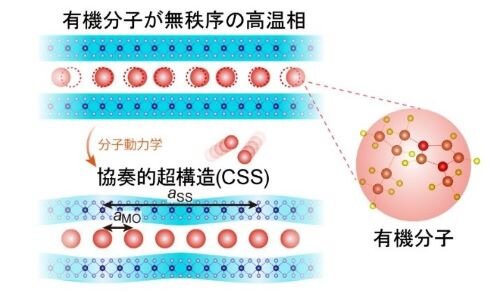
分子動力学に駆動された協奏的超構造の発現
<関連情報>
分子インターカレーション超格子における秩序・無秩序ダイナミクスを介した協同的な超構造の出現 Emergent cooperative superstructures via order-disorder kinetics in molecular intercalation superlattices
Taiga Ueda, Hideki Matsuoka, Shungo Aoyagi, Shunsuke Kitou, […] , and Naoya Kanazawa
Science Advances Published:5 Aug 2026
DOI:https://doi.org/10.1126/sciadv.aeg4785
Abstract
Molecular intercalation superlattices, formed by inserting organic molecules into van der Waals crystals, create inorganic-organic hybrid interfaces that have enabled a variety of emergent phenomena. Traditionally, the intercalated molecules have been regarded as inactive spacers, while their collective ordering have remained largely unexplored. Here, we report the discovery of a cooperative superstructure phase in molecule-intercalated niobium diselenide (NbSe2), where ordering of the guest molecules induce a superstructure in the NbSe2 host lattice, characterized by a moiré structure due to incommensurability between molecular and inorganic lattices. Thermal-quench measurements show that the transition is governed by slow order-disorder kinetics, contrasting with fast charge or magnetic ordering in inorganic solids. Our findings establish molecular ordering as a route for engineering heterointerfaces, enabling thermally programmable superstructures.