2026-08-05 バージニア工科大学(Virginia Tech)
<関連情報>
- https://news.vt.edu/articles/2026/08/science-chemistry-liu-pvc-lubricant.html
- https://www.nature.com/articles/s41586-026-10867-z
- https://www.nature.com/articles/s41893-024-01464-x
- https://www.science.org/doi/10.1126/science.adh0993
ポリ塩化ビニルをポリアルファオレフィン潤滑剤にアップサイクルする Upcycling of polyvinyl chloride into polyalphaolefin lubricants
Eric Munyaneza Nuwayo,Connor Thompson,Abby Civiello,Adrian DiMarco,Jingtao Zhang,Seungjoo Lee,Gugyeong Sung,Tridip Das,Yue Zhang,Clark Vu,Shelby Koshak,John B. Matson,Ali Erdemir,William A. Goddard III,Xi Chen & Guoliang Liu
Nature Published:05 August 2026
DOI:https://doi.org/10.1038/s41586-026-10867-z
Abstract
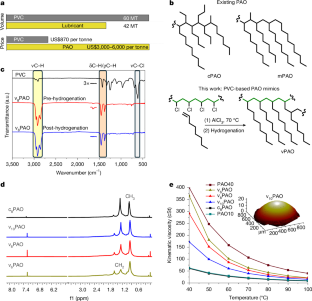
Polyvinyl chloride (PVC) is a thermoplastic used ubiquitously in households and industry owing to its light weight, mechanical strength, durability, low cost and ultraviolet and fire resistance1,2. With a production volume of about 60 million tonnes annually2, post-consumer and post-industrial PVC waste pose marked environmental challenges, such as leaching chlorohydrocarbons and additives, which contaminate groundwater and soil1,2,3,4. To address the formidable challenge of recycling PVC and achieving carbon circularity, valorization into high-value products is essential to mitigate the associated costs and offer high financial incentives for reusing plastic waste5,6,7,8,9,10,11,12,13,14. Here we report a method for upcycling PVC into high-value lubricants with controllable viscosities. Using AlCl3 at a mild temperature of 70 °C, PVC undergoes dechlorination, alkylation and chain scission, producing vinyl-derived polyalphaolefins (vPAO). PVC serves as an effective template for the alkylation of α-olefins of various chain lengths, producing vPAO with limited short branches in the backbone without the need for metallocene catalysts essential to current PAO technology. The PVC-derived lubricants exhibit tunable molar masses, kinematic viscosities at 100 °C (KV100 ≈ 14.9–26.3 centistokes), a low coefficient of friction (COF ≈ 0.08–0.15) and a high viscosity index (VI up to 130). This work highlights an economical approach to using PVC as a low-cost feedstock to synthesize high-value lubricants with superior tribological properties, meeting the demand for sustainability in both the plastic and lubricant industries.
ポリオレフィンの鎖長制御による硫酸系洗剤へのアップサイクル Chain-length-controllable upcycling of polyolefins to sulfate detergents
Nuwayo Eric Munyaneza,Ruiyang Ji,Adrian DiMarco,Joel Miscall,Lisa Stanley,Nicholas Rorrer,Rui Qiao & Guoliang Liu
Nature Sustainability Published:18 November 2024
DOI:https://doi.org/10.1038/s41893-024-01464-x
Abstract
Escalating global plastic pollution and the depletion of fossil-based resources underscore the urgent need for innovative end-of-life plastic management strategies in the context of a circular economy. Thermolysis is capable of upcycling end-of-life plastics to intermediate molecules suitable for downstream conversion to eventually high-value chemicals, but tuning the molar mass distribution of the products is challenging. Here we report a temperature-gradient thermolysis strategy for the conversion of polyethylene and polypropylene into hydrocarbons with tunable molar mass distributions. The whole thermolysis process is catalyst- and hydrogen-free. The thermolysis of polyethylene and polyethylene/polypropylene mixtures with tailored temperature gradients generated oil with an average chain length of ~C14. The oil featured a high concentration of synthetically useful α-olefins. Computational fluid dynamics simulations revealed that regulating the reactor wall temperature was the key to tuning the hydrocarbon distributions. Subsequent oxidation of the obtained α-olefins by sulfuric acid and neutralization by potassium hydroxide afforded sulfate detergents with excellent foaming behaviour and emulsifying capacity and low critical micelle concentration. Overall, this work provides a viable approach to producing value-added chemicals from end-of-life plastics, improving the circularity of the anthropogenic carbon cycle.
ポリエチレン、ポリプロピレン、およびこれらの混合物から高付加価値界面活性剤への化学的アップサイクル Chemical upcycling of polyethylene, polypropylene, and mixtures to high-value surfactants
Zhen Xu, Nuwayo Eric Munyaneza, Qikun Zhang, Mengqi Sun, […] , and Guoliang Liu
Science Published:10 Aug 2023
DOI:https://doi.org/10.1126/science.adh0993
Abstract
Conversion of plastic wastes to fatty acids is an attractive means to supplement the sourcing of these high-value, high-volume chemicals. We report a method for transforming polyethylene (PE) and polypropylene (PP) at ~80% conversion to fatty acids with number-average molar masses of up to ~700 and 670 daltons, respectively. The process is applicable to municipal PE and PP wastes and their mixtures. Temperature-gradient thermolysis is the key to controllably degrading PE and PP into waxes and inhibiting the production of small molecules. The waxes are upcycled to fatty acids by oxidation over manganese stearate and subsequent processing. PP ꞵ-scission produces more olefin wax and yields higher acid-number fatty acids than does PE ꞵ-scission. We further convert the fatty acids to high-value, large–market-volume surfactants. Industrial-scale technoeconomic analysis suggests economic viability without the need for subsidies.