2026-07-22 NASA
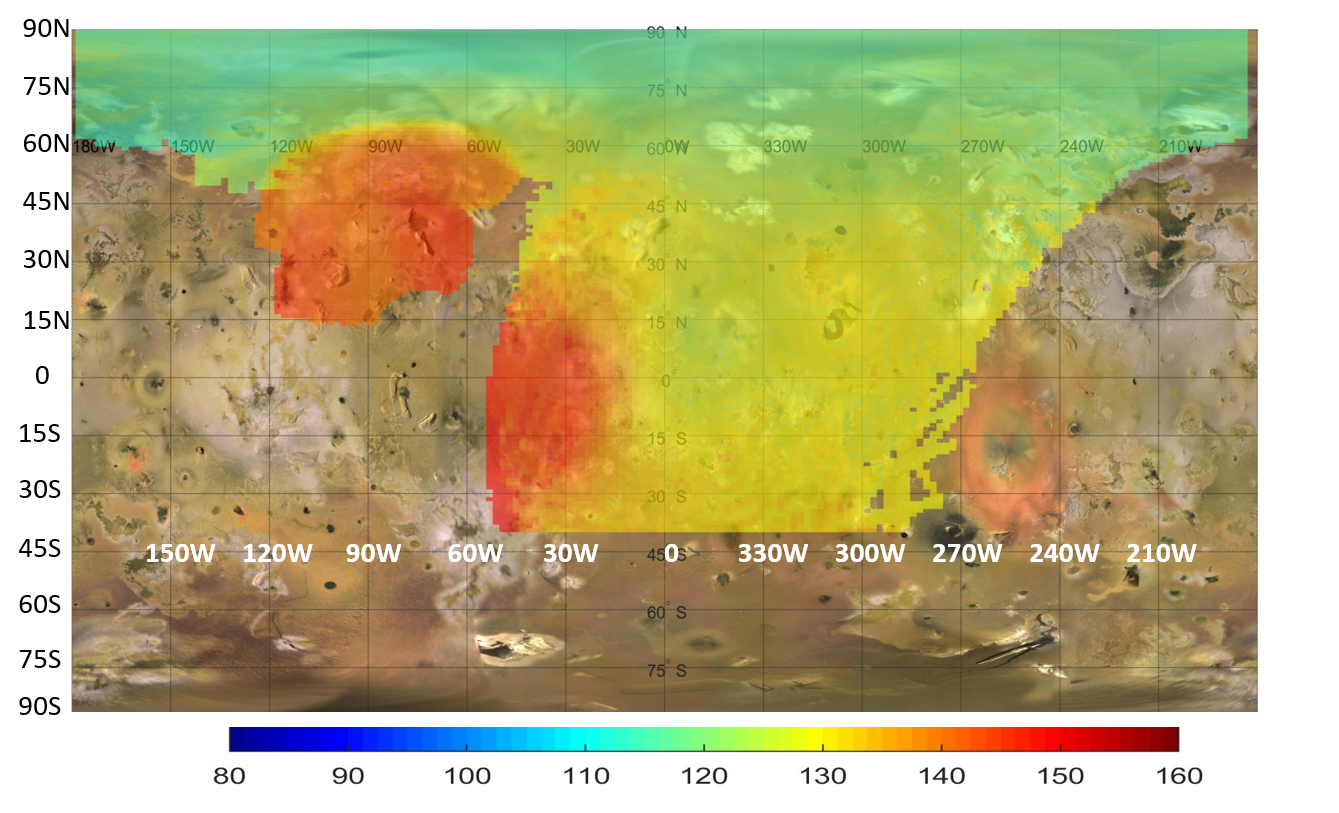
This map represents data captured by the Microwave Radiometer instrument aboard NASA’s Juno, indicating heat rising from just beneath the surface of Jupiter’s moon Io. The colors illustrate a distinct temperature gradient across the moon, with the most extreme, localized heat output in red. NASA/JPL-Caltech/SwRI/USGS
<関連情報>
- https://www.nasa.gov/missions/juno/nasas-juno-takes-temperature-of-jupiters-fiery-moon-io/
- https://agupubs.onlinelibrary.wiley.com/doi/10.1029/2025JE009622
ジュノー探査機のマイクロ波放射計が観測したイオの地下温度プロファイル Io Sub-Surface Temperature Profile Observed by the Juno Microwave Radiometer
Shannon Brown, Virgil Adumitroaie, Scott Bolton, Anton Ermakov, Jianqing Feng, Steven Levin, Matthew Siegler, Zhimeng Zhang
Journal of Geophysical Research: Planets Published:22 July 2026
DOI:https://doi.org/10.1029/2025JE009622
Abstract
We report on new observations of Io upwelling thermal emission over the range of 0.6–22 GHz acquired with the Juno Microwave Radiometer in December 2023 and February 2024. The microwave emission spectrum from the surface of Io is retrieved from the calibrated brightness temperatures by characterizing and removing reflections from the sky. The surface appears to exhibit specular reflection in the microwave, suggesting a relatively smooth surface on 100 km spatial scales (apart from visible topography), like Earth’s land and ocean surfaces. The real part of the dielectric constant is found to be in the range of 2–4; constrained by overlapping observations on the surface from two viewing geometries. This relatively low value is consistent with a density of 0.7–1.1 g/cm3 of the surface layer (<10 cm depth). A large spectral slope is observed at all latitudes in the lowest frequency channels suggesting significant endogenic near-surface heating. Two simple models are applied to explain the MWR spectra. A model with a conducive near-surface layer implies heat flows ranging from 1 to 3 W/m2. Alternately, relatively fresh lava flows (<5 years) or heat vents covered by a cooling crust on the order of 10 m over about 10% of the surface area can also explain the spectral gradient.