2026-07-20 合肥物質科学研究院(HFIPS)
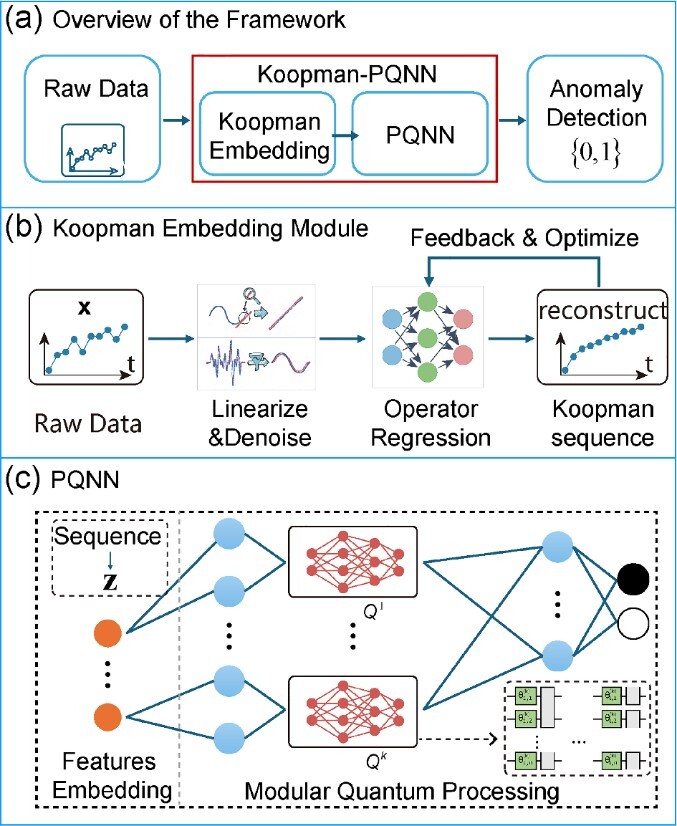
Schematic diagram of the algorithm: (a) Classical-quantum hybrid framework; (b) Koopman embedding module; (c) Parallel quantum neural network (PQNN). (Image by LAN Ting)
<関連情報>
- https://english.hf.cas.cn/nr/rn/202607/t20260720_1178708.html
- https://link.springer.com/article/10.1007/s11433-026-2962-1
核融合装置の診断ノイズ除去のためのクープマン・量子ハイブリッドパラダイムの検証 Validating a Koopman-quantum hybrid paradigm for diagnostic denoising of fusion devices
Tie-Jun Wang,Run-Qing Zhang,Ling Qian,Yun-Tao Song,Ting Lan,Hai-Qing Liu & Keren Li
Science China Physics, Mechanics & Astronomy Published:19 May 2026
DOI:https://doi.org/10.1007/s11433-026-2962-1
Abstract
Quantum machine learning in data-intensive science is limited by the difficulty of interfacing high-dimensional, chaotic classical data with resource-limited quantum processors. To address this issue, we study a physics-informed Koopman-quantum hybrid framework motivated by a representation-level correspondence between Koopman operator evolution and quantum evolution. On this basis, we build a compact hybrid pipeline in which Koopman analysis distills raw waveforms into low-dimensional residual statistics that are then processed by a modular parallel quantum neural network. We test the framework on 4763 labeled channel sequences from 433 tokamak discharges. The main PQNN benchmark uses classical preprocessing followed by noiseless circuit simulation and achieves about 97.0% accuracy in screening corrupted diagnostic data while using far fewer trainable parameters than a deep CNN baseline. Additionally, we complement this benchmark with two simplified, hardware-motivated noise sources: finite-shot/readout uncertainty and effective perturbations to PQNN expectation values. These checks indicate qualitative stability under moderate device-relevant perturbations, while also highlighting the remaining gap to platform-specific hardware validation.