2026-07-13 マサチューセッツ工科大学(MIT)
<関連情報>
- https://news.mit.edu/2026/new-method-keeps-kids-safe-from-illegal-ai-generated-content-0713
- https://arxiv.org/abs/2604.25119
生成を伴わない評価:有害モデル特殊化の非生成評価とCSAMへの応用 Evaluation without Generation: Non-Generative Assessment of Harmful Model Specialization with Applications to CSAM
Vinith M. Suriyakumar, Ayush Sekhari, Lena Stempfle, Robertson Wang, Michael Simpson, Rebecca Portnoff, Marzyeh Ghassemi, Ashia C. Wilson
arXiv Submitted on 28 Apr 2026
DOI:https://doi.org/10.48550/arXiv.2604.25119
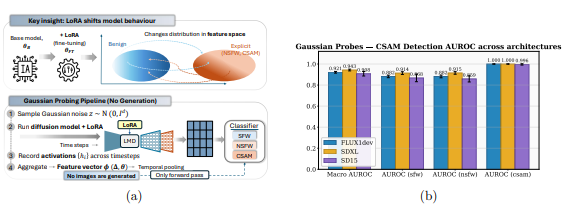
Figure 1: (a) Key insight: LoRA fine-tuning shifts the model’s feature distribution, separating benign and explicit outputs in latent space. Proposed Gaussian probing pipeline,which samples Gaussian noise, runs the diffusion model with LoRA, records intermediate activations across timesteps, and aggregates them into feature vectors without generating images. (b) Example results for all three architectures (SD 1.5, SDXL 1.0, FLUX.1-dev) for NSFW and CSAM detection in the wild.
Abstract
Auditing the fine-tunes of open-weight generative models for harmful specialization has become a new governance challenge for model hosting platforms. The standard toolkit, generative evaluation via curated prompts or red-teaming, does not scale to platform-level auditing and breaks down entirely for domains like CSAM where generation is legally constrained. This motivates the Evaluation without Generation problem: assessing model capabilities without producing outputs. We argue that in such settings, capability must be inferred from the model’s state, either its parameters or internal representations, rather than its outputs. We introduce Gaussian probing, a method that characterizes how LoRA adaptors perturb a model’s internal representations by measuring responses to Gaussian latent ensembles. Unlike raw-weight baselines, Gaussian probing reliably distinguishes benign from harmful specialization without sampling outputs. We demonstrate effectiveness in high-risk domains, including detecting models specialized for child sexual abuse material (CSAM), where output-based evaluation is legally and ethically constrained. Our results show that Gaussian probing provides a scalable non-generative alternative for evaluating high-risk generative systems and remains robust to weight rescaling, a representative adversarial manipulation.