2026-07-16 中国科学院(CAS)
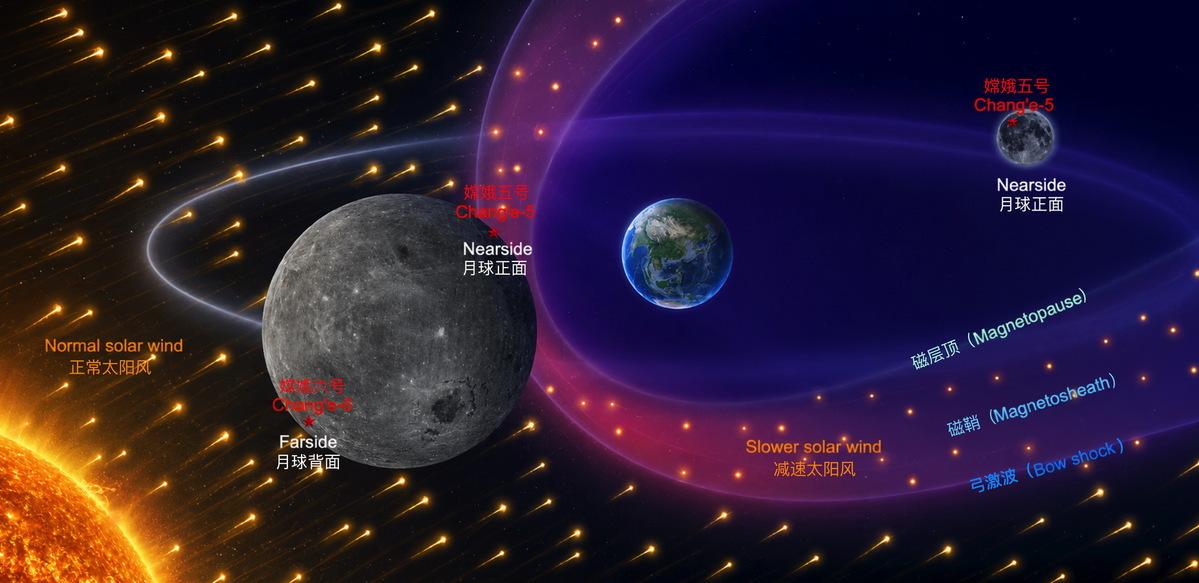
Solar wind differences between the lunar nearside and farside under the influence of Earth’s magnetosphere. [Photo provided to chinadaily.com.cn]
<関連情報>
- https://english.cas.cn/newsroom/cas-in-media/202607/t20260716_1178504.shtml
- https://www.nature.com/articles/s41561-026-02042-w
希ガス記録に基づく、月の裏側における太陽風のより深い浸透 Deeper solar wind penetration on the Moon’s farside from noble gas records
Xu-Hang Zhang,Fei Su,You-Juan Li,Zi-Heng Liu,Jian-Nan Li,Ying-Nan Zhang,Li-Ping Qin,Ran-Ran Liu,Feng Man,Bing Xu,Wen-Zhe Li,Yong Wei & Huai-Yu He
Nature Geoscience Published:15 July 2026
DOI:https://doi.org/10.1038/s41561-026-02042-w
Abstract
As the Moon lacked an atmosphere and global magnetic field for much of its history, volatile elements in lunar soils are established to originate primarily from solar wind irradiation and meteorite and comet impacts. Potential differences in volatiles and their origins between the near and far sides of the Moon are not well understood. Here we report the noble gas compositions of lunar farside soils sampled by Chang’e-6. The samples have low neon (Ne) isotope ratios, whereas krypton (Kr) and xenon (Xe) isotope ratios are distinct from those of meteoritic and cometary components and are solar wind-derived. Release patterns for krypton and xenon also indicate deeper solar wind penetration on the Moon’s farside, in contrast to Chang’e-5 and other nearside samples. This hemispheric difference can be explained by partially decelerated solar wind, slowed to ~200 km s−1, reaching the Moon’s nearside as it passes through Earth’s magnetosphere, a process that does not occur for the farside Chang’e-6 soils. Thus, the Earth’s magnetosphere influences the overall velocity of solar wind bombarding the Moon, affecting its volatile distribution and isotopic variations.