2026-07-09 中国科学院(CAS)
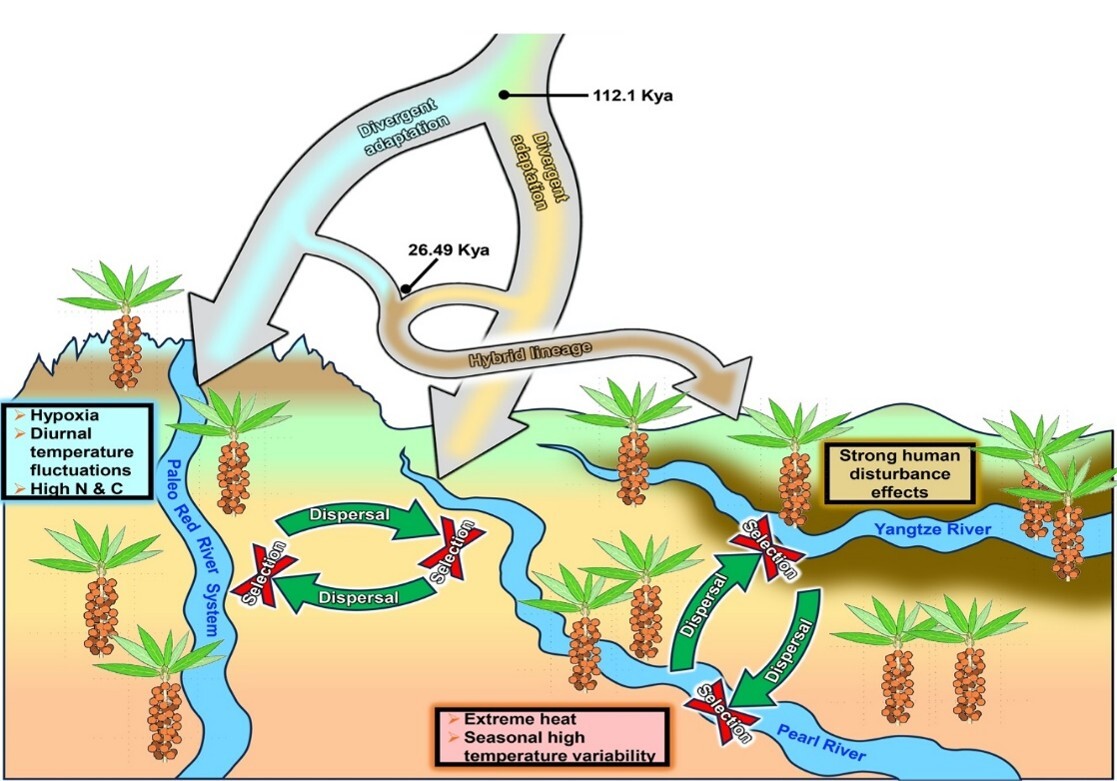
Morphology, habitat and geographical distribution of D. orientalis. (Image by KIB)
<関連情報>
- https://english.cas.cn/newsroom/research-news/202607/t20260710_1176950.shtml
- https://onlinelibrary.wiley.com/doi/10.1111/jipb.70336
気候変動によるニッチフィルタリングが、河畔低木における分散後の定着とゲノム浸透を制限する Climate-driven niche filtering limits post-dispersal establishment and genomic introgression in a riverine shrub
Zeng-Yuan Wu, Mark A. Chapman, Richard I. Milne, Jie Liu, Ya-Huang Luo, Peng-Zhen Fan, Guang-Fu Zhu, Jason T. Weir, Richard T. Corlett, Xiao-Gang Fu, Toby P. N. Tsang, Marc W. Cadotte, De-Zhu Li
Journal of Integrative Plant Biology Published: 06 July 2026
DOI:https://doi.org/10.1111/jipb.70336
ABSTRACT
Dispersal enables species to track climate change by facilitating range shifts and colonization, yet successful post-dispersal establishment is often constrained by ecological niche mismatches. The mechanisms underlying this constraint remain poorly understood due to a lack of molecular evidence, limiting our ability to predict climate-induced range dynamics. Here, we integrate biogeographic analysis with macroecological insights to investigate how ecology shapes genomic divergence, local adaptation, and climate resilience in Debregeasia orientalis C. J. Chen, a dominant riparian shrub distributed across multiple biodiversity hotspots in southwestern China. Based on whole genome sequencing data from 332 individuals, we identify three genetically distinct groups: two diverged during the early Last Glacial period, and one originated through hybridization more recently. Despite both historical and ongoing opportunities for gene flow, strong genetic differentiation persists among the three groups. This differentiation is supported by clear niche divergence among the three groups and by genomic signatures of local adaptation, including selective sweeps related to hypoxia tolerance, thermal adaptation, and anthropogenic pressures. Together, these findings indicate that post-dispersal niche filtering limits the merging of these lineages. Genomic offset projections reveal asymmetric vulnerabilities to future climate scenarios, with one lineage particularly maladapted under projected shifts. These findings highlight niche-driven adaptation as a primary determinant of both historical divergence and contemporary resilience. Collectively, this study presents a framework linking post-dispersal ecological filtering to long-term genomic divergence, offering new insights into how niche filtering maintains genetic structure under rapid environmental change.