2026-04-02 高知大学
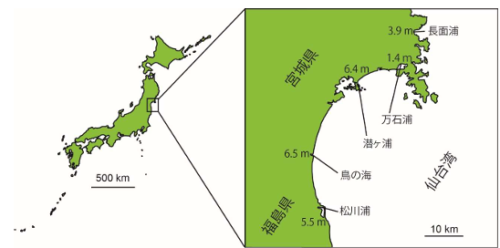
図1.約20年にわたる継続調査を行った5つの干潟と干潟周辺で観測された津波の高さ。仙台湾周辺の松川浦(まつかわうら;福島県相馬市)、鳥の海(とりのうみ;宮城県亘理町)、潜ヶ浦(かつぎがうら;宮城県東松島市)、万石浦(まんごくうら:宮城県石巻市)、長面浦(ながつらうら;宮城県石巻市)。
<関連情報>
- https://www.kochi-u.ac.jp/news/総合科学系複合領域科学部門の三浦収教授らの研/
- https://www.kochi-u.ac.jp/wp-content/uploads/2026/04/【WEB掲載版】約20年にわたる野外調査が物語る東日本大震災の干潟生態系への爪痕_0402.pdf
- https://royalsocietypublishing.org/rstb/article/381/1945/20240325/480683/The-long-term-effects-of-the-tsunamis-caused-by
東日本大震災による津波が潮間帯の宿主・寄生生物系に及ぼす長期的な影響 The long-term effects of the tsunamis caused by the Great East Japan Earthquake on an intertidal host–parasite system
Osamu Miura;Shizuko Nakai;Hajime Itoh;Gen Kanaya
Philosophical Transactions of the Royal Society B Published:05 Mar 2026
DOI:https://doi.org/10.1098/rstb.2024.0325
Abstract
Due to the intimate relationship between hosts and parasites, parasites can be used as an indicator of host demography and provide a useful monitoring tool for conservation management. The tsunamis caused by the Great East Japan Earthquake damaged a large number of coastal organisms that host various parasite species. We monitored the demography of trematode parasites and their first intermediate host, the intertidal mud snail Batillaria attramentaria, between 2005 and 2024 to evaluate the impact of the tsunami on this snail–trematode system. We further investigated the changes in the community structure of potential second intermediate hosts (macrobenthic organisms) and definitive hosts (shorebirds) using the public database to evaluate their associations with trematode communities. Our long-term monitoring demonstrated that the trematode prevalence and diversity have fluctuated for more than 10 years after the tsunami event. The observed instability of parasite communities can be partially explained by the demographic imbalance of host populations and perhaps by other factors, including human activity, gradual land elevation and global climate change. Our study highlights the recovery process of coastal organisms from the tsunami disturbance and the potential usefulness of trematode parasites in monitoring their associated host communities.