2026-07-09 ブラウン大学
<関連情報>
- https://www.brown.edu/news/2026-07-09/chemical-bonds-relativity
- https://www.science.org/doi/10.1126/science.aei1285
CBi−分子イオンにおける古典的な三重結合の相対論的崩壊 Relativistic collapse of the classical triple bond in the CBi− molecular ion
Deniz Kahraman, Jie Hui , Xin-Yu Zhang, Neil A. Ellis, […] , and Lai-Sheng Wang
Science Published:9 Jul 2026
DOI:https://doi.org/10.1126/science.aei1285
Abstract
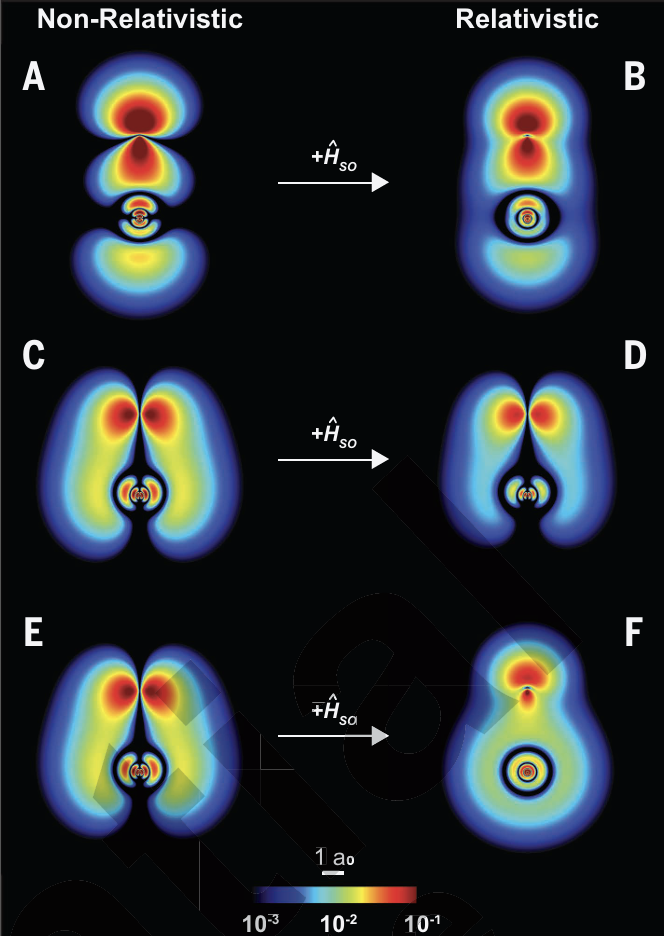
The conventional framework for chemical bonding between main-group elements involves separate σ and π orbitals to describe multiple bonds. However, relativistic effects mix these orbitals in molecules containing heavy elements through spin–orbit coupling, leaving the total angular-momentum projection (ω) as the only good quantum number. Direct experimental evidence that relativistic effects change the σ-π bonding framework has remained elusive. Here, we probe the carbon-bismuth triple bond in the CBi− anion using high-resolution cryogenic photoelectron spectroscopy, coupled with relativistic four-component Dirac-Coulomb coupled-cluster calculations. Even though the CBi− anion is isovalent to the well-known CN− species, we demonstrate that the traditional σ + 2π triple-bond picture collapses into a pure π-like |ω| = 3/2 and two |ω| = 1/2 Kramers pairs containing substantial σ/π mixing.