2026-06-29 カリフォルニア大学ロサンゼルス校(UCLA)
Maher El-Kady/UCLA
<関連情報>
- https://newsroom.ucla.edu/releases/3d-printing-to-develop-zinc-iron-battery-massive-energy-ucla
- https://onlinelibrary.wiley.com/doi/10.1002/smll.202514911
亜鉛イオンスーパーキャパシタ用3Dプリント炭素格子上に高質量負荷酸化バナジウムを担持 High Mass-Loading Vanadium Oxide on 3D Printed Carbon Lattices for Zinc-Ion Supercapacitors
Sophia Uemura, Celeste Elkort, Kaitlyn Than, Sydney Rapier, Yuto Katsuyama, Joanne Hui, Zhiyin Yang, Hung-Yi Huang, Chi-Chang Hu, Maher F. El-Kady, Richard B. Kaner
Small Published: 17 March 2026
DOI:https://doi.org/10.1002/smll.202514911
ABSTRACT
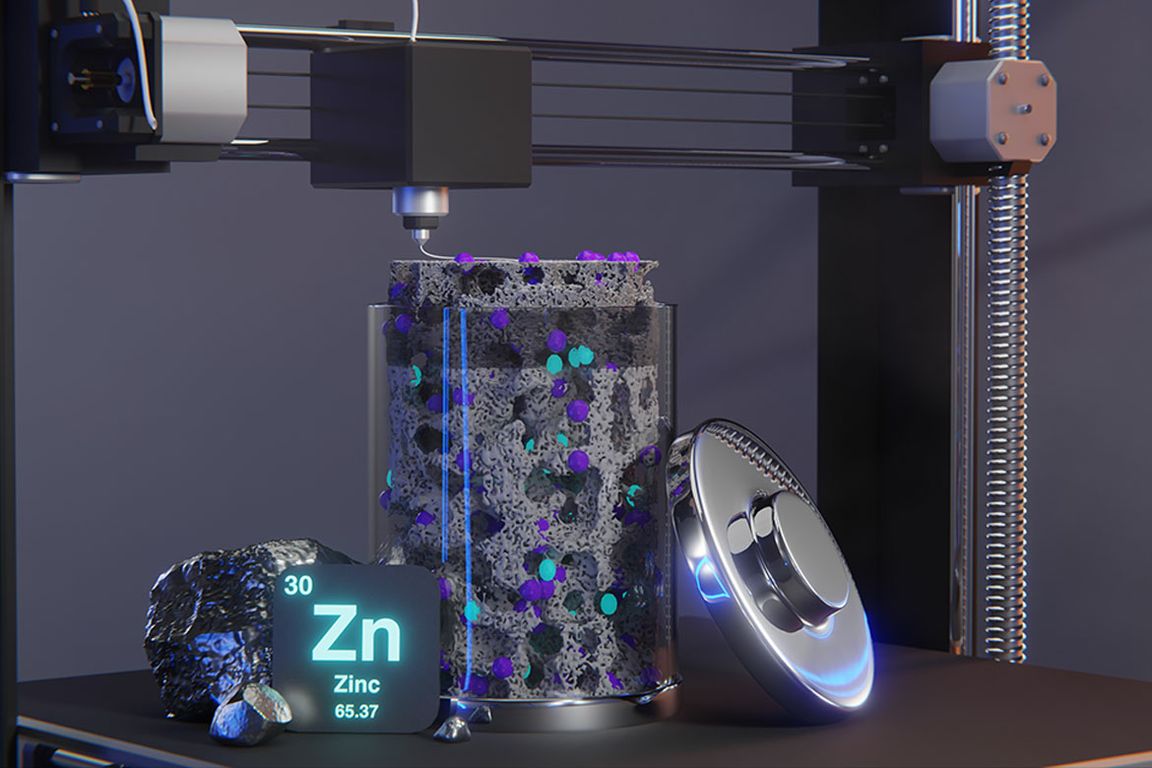
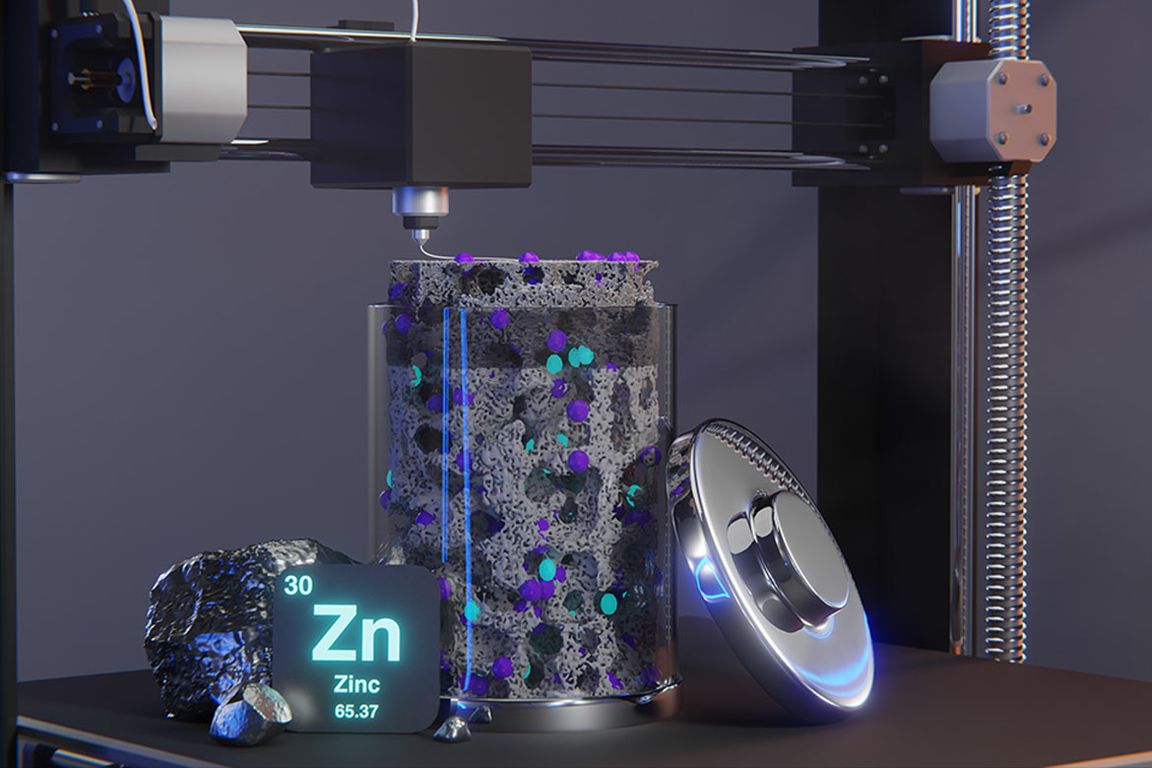
The rising demand for sustainable and scalable energy storage systems has accelerated the development of aqueous zinc-based technologies. However, conventional slurry-cast planar electrodes underperform at high mass loading, causing low areal capacitance and sluggish rate performance. Herein, we introduce a 3D printed freestanding, binder-free conductive carbon lattice electrode integrated with vanadium oxide (VOx). The 3D framework facilitates homogeneous dispersion of VOx, increasing the electroactive surface area, enhancing the ion transport ability, and maintaining structural integrity under high current density. Enabled by this architecture and a high mass loading of 38 mg cm−2, the electrode achieves areal capacitance of 7129 mF cm−2 at 3 mA cm−2, areal power and energy densities of 44 mW cm−2 and 1 mWh cm−2, along with robust cycling performance, with a capacity retention of 82% after 1500 cycles. To ensure rigorous and reproducible evaluation, we introduce a sealed, 3D-printed test cell that fixes the inter-electrode spacing and suppresses electrolyte evaporation. Compared with open beaker setups commonly used for three-electrode measurements, the printed cell yields more consistent capacitance and resistance. It also maintains 98% capacity retention after 1400 cycles. This synergy of 3D engineered electrodes and cells provides a reproducible pathway to practical, high-energy, and power-density zinc-ion supercapacitors.