2026-06-30 東北大学
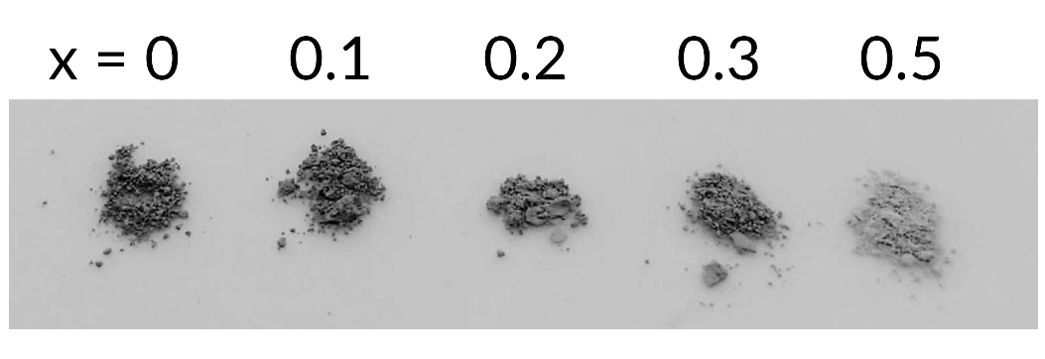
図1. Ba(Zr1-xScx)O3(x=0〜0.5)にScと同量(x)のH⁻を導入した粉末の外観
<関連情報>
- https://www.tohoku.ac.jp/japanese/2026/06/press20260630-05-hydride.html
- https://pubs.rsc.org/ta/article/doi/10.1039/d6ta02652d/1267417/Thermally-stable-and-tunable-hydride-ion
ScドープBaZrO3における熱的に安定で調整可能な水素化物イオンの取り込み
Thermally stable and tunable hydride-ion incorporation in Sc-doped BaZrO3
Itsuki Yaegashi;Itaru Oikawa;Akihiro Ishii;Hikaru Takeuchi;Yuki Sasahara;Daichi Kato;Hiroshi Kageyama;Hitoshi Takamura
Journal of Materials Chemistry A Published:26 June 2026
DOI:https://doi.org/10.1039/d6ta02652d
Hydride ions (H−) endow oxides with various functionalities such as catalytic activity and superconductivity. However, precise control of the H− content is difficult because introduction of H− depends on the reduction of transition-metal cations, which is governed not only by thermodynamic parameters such as T and pO2 but also by kinetics. Additionally, charge compensation by unstable reduced cations makes H− thermally unstable. This study proposes to enable H− introduction by acceptor doping, where the H− content is stoichiometric and its thermostability is enhanced owing to stable acceptors. Based on the defect formation energy calculations, Sc-doped BaZrO3 was selected as a host oxide and heat-treated with CaH2 at 500 °C for 48 h. Even under a strong reducing atmosphere, cation reduction hardly occurred, as confirmed by unchanged lattice parameters and the absence of Zr3+ electron paramagnetic resonance peaks. 1H MAS NMR spectra revealed that H− was successfully introduced and its content was precisely controlled by the acceptor doping level. Moreover, H− compensated by the acceptor was retained above 800 °C regardless of H− content, and Sc doping preferentially stabilized cis coordination, as confirmed by 45Sc MAS NMR. Therefore, acceptor doping offers an effective approach for introducing stoichiometric and thermally stable H− into oxides.