2026-06-30 カリフォルニア大学アーバイン校(UCI)
<関連情報>
- https://news.uci.edu/2026/06/30/uc-irvine-astronomers-discover-a-new-earth-like-exoplanet/
- https://iopscience.iop.org/article/10.3847/1538-4357/ae732b
居住可能領域スーパーアースGJ 3378 bの質量と周期の改訂:宇宙の海岸線にまたがる惑星 A Revised Mass and Period for the Habitable Zone super-Earth GJ 3378 b: A Planet Straddling the Cosmic Shoreline
Paul Robertson, Michael Endl, William D. Cochran, Gudmundur Stefansson, Suvrath Mahadevan, Caleb I. Cañas, Gogod James, Roan Arendtsz, Ryan C. Terrien, Chad F. Bender,…
The Astrophysical Journal Published: 2026 June 30
DOI:10.3847/1538-4357/ae732b
Abstract
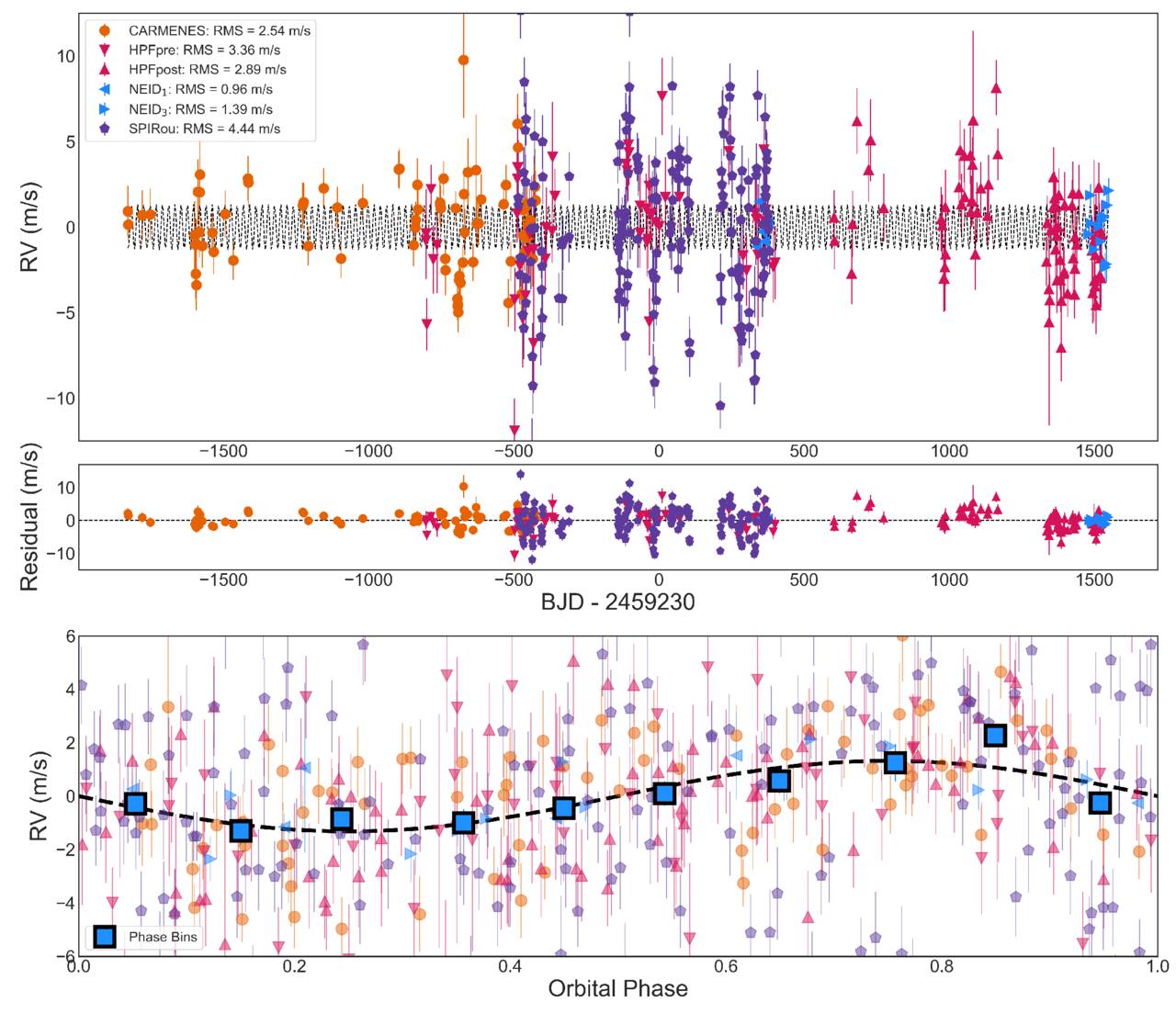
The nearby (d = 7.7 pc) M4V star GJ 3378 is a target of our radial velocity (RV) exoplanet survey of fully convective stars in the solar neighborhood with the near-IR Habitable-zone Planet Finder (HPF) spectrometer on the Hobby–Eberly Telescope (HET) at McDonald Observatory. Recently, C. Moutou et al. announced the discovery of an m sin i 5.26+0.94-0.97M⊕ planet, GJ 3378 b, with an orbital period of 24.73 ± 0.06 days, based on SPIRou RV data. Here, we present our HPF RVs for GJ 3378, as well as additional Doppler spectroscopy from the extreme-precision NEID spectrometer on the WIYN telescope at Kitt Peak National Observatory. We have analyzed the HPF + NEID RVs jointly with the published RVs from the CARMENES and SPIRou spectrometers. We present an orbital model for GJ 3378 b that differs significantly from the C. Moutou et al. solution. The joint RV model reduces the orbital period to P = 21.45 ± 0.01 days and the minimum mass to m sin i 2.3±M⊕. The shortened orbital distance remains within the conservative circumstellar liquid-water habitable zone (HZ), while the reduced mass increases the likelihood that the planet has a terrestrial composition. The revised planet properties place it near the “cosmic shoreline,” where planets in the HZs of M dwarfs may lose their atmospheres due to radiative stripping.