2026-06-30 サンディア国立研究所
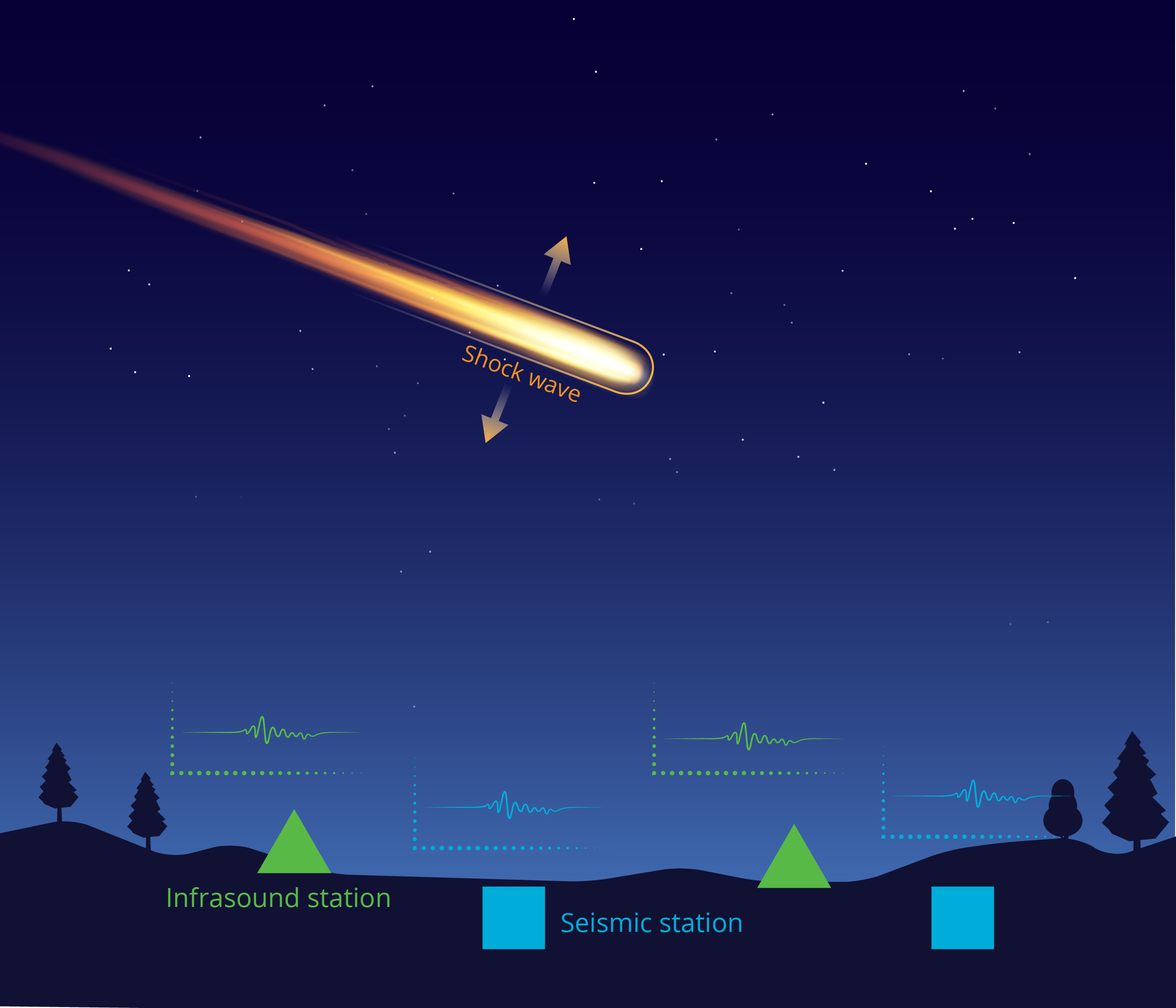
The fireball generated low-frequency sound waves that traveled hundreds of miles across Alaska. A total of 57 different earthquake and volcano-monitoring sensors recorded signals, giving the team enough data to begin reconstructing the fireball’s path, even without the kind of optical record scientists would normally hope to have. (Graphic by Vickie Aranda) Click on the graphic for a high-resolution image.
<関連情報>
- https://newsreleases.sandia.gov/how-scientists-support-planetary-defense-by-reconstructing-a-fireballs-path-using-sound-waves/
- https://agupubs.onlinelibrary.wiley.com/doi/10.1029/2025JE009440
2025年4月24日アラスカ火球のマルチセンサー軌道再構築と惑星防衛への影響 Multi-Sensor Trajectory Reconstruction of the 24 April 2025 Alaska Fireball and Implications for Planetary Defense
L. T. Scamfer, E. A. Silber, M. D Fries, D. Vida, D. Šegon, P. Jenniskens, Y. Nishikawa, V. Sawal, T. A. Rector
Journal of Geophysical Research: Planets Published: 27 March 2026
DOI:https://doi.org/10.1029/2025JE009440
Abstract
On 24 April 2025 at 18:30:57 UTC, a bright daytime fireball over Southcentral Alaska was detected by 37 seismic stations, 16 single infrasound sensors, and four infrasound arrays, yielding 30 ballistic and multiple fragmentation arrivals. The unprecedented density of seismoacoustic coverage enabled detailed reconstruction of the event using acoustic signals, with fragmentation source locations further guiding the identification of Doppler weather radar signatures of a meteorite fall. Incorporation of a radar-derived terminal point yielded a final trajectory solution, which agreed closely with an independent optical trajectory solution from video analysis. The reconstructed entry parameters from seismoacoustic analysis indicate a velocity of 25.3 km/s, an entry angle of 19°, and an energy release of ∼38 t TNT equivalent. Assuming a chondritic composition, the pre-entry object diameter was ∼0.7 m. Using orbital parameters from the optical solution, we estimate meteoroid composition as most likely an L-type ordinary chondrite. The event occurred in the sub-Arctic, where space-based optical systems face challenges in detection, demonstrating the critical role of dense ground-based seismoacoustic networks in characterizing high-latitude atmospheric entries. This uniquely well-recorded event demonstrates the capability of dense seismoacoustic networks to constrain bolide trajectories, energetics, and fragmentation, with radar and optical data providing critical confirmation and complementary perspectives. These results bridge the methodological gap between planetary-defense monitoring of natural impactors and space-traffic analyses of artificial reentries, illustrating how multi-sensor integration can deliver calibration-grade trajectories even for unpredicted events.