2026-06-29 中国科学院(CAS)
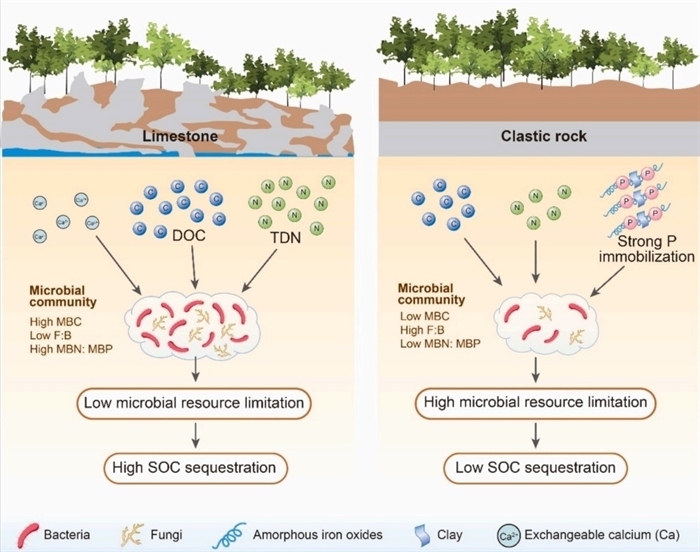
Diagram illustrating the lithological controls on microbial resource limitation and soil organic C sequestration in subtropical forests (Image by XIAO Kongcao)
<関連情報>
- https://english.cas.cn/newsroom/research-news/202606/t20260624_1174535.shtml
- https://www.sciencedirect.com/science/article/pii/S0341816226005278
中国南西部の亜熱帯林における土壌微生物資源制限に対する岩石学的制御 Lithological controls on soil microbial resource limitation in subtropical forests of southwest China
Kongcao Xiao, Pengpeng Duan, Dejun Li
CATENA Available online: 20 June 2026
DOI:https://doi.org/10.1016/j.catena.2026.110317
Highlights
- Soil microbes in forests over clastic rock were more limited by C and P than those over limestone.
- Lithology modulates soil microbial resource limitation by inheriting soil geochemistry.
- Lithology, rather than climate, critically shapes the pattern of microbial resource limitation in forests of southwest China.
Abstract
Resource constraints on soil microbial metabolism critically influence biogeochemical cycling and ecosystem functioning. However, the drivers and mechanisms underlying soil microbial resource limitation, particularly across broad spatial scales, remain incompletely understood. Here, we investigated patterns of soil microbial resource limitation using enzymatic stoichiometry in subtropical forests developed on two contrasting lithologies (limestone and clastic rock) in southwest China, and explored linkages with climatic, plant, microbial traits (i.e., biomass and community composition measured via qPCR), and soil geochemical factors. Activities of carbon (C)-, nitrogen (N)-, and phosphorus (P)-acquiring enzymes and their stoichiometric ratios differed significantly between lithologies. Vector analysis revealed that soil microbes in clastic rock forests experienced greater C and P limitation, whereas those in limestone forests were more N-limited. Random forest and structural equation modeling identified lithology, rather than climate, as the primary factor regulating microbial resource limitation within this subtropical region, primarily through its influence on soil geochemistry and microbial traits. These findings underscore the predominant role of lithology in shaping soil microbial resource limitation in subtropical forests, with significant implications for understanding nutrient cycling and carbon sequestration in these globally important ecosystems.