2026-06-24 産業技術総合研究所
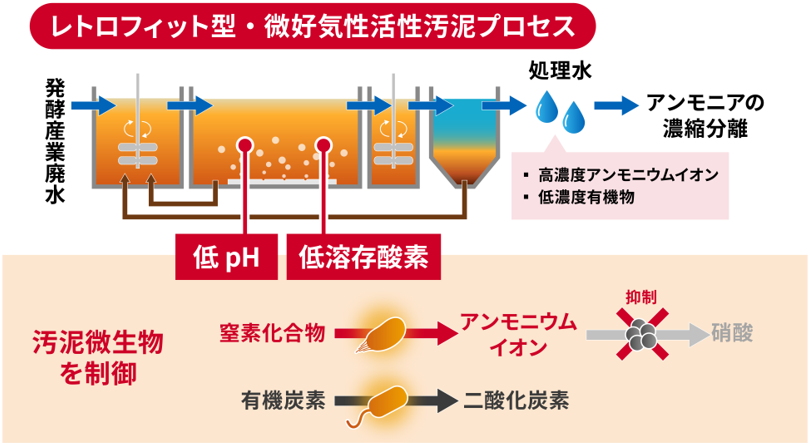
概要図 微好気性活性汚泥プロセスにおける装置概要と活性汚泥微生物群集の制御戦略。
上段はプロセスフローを示す。青の矢印は水の流れ、茶の矢印は汚泥の流れを示す。
<関連情報>
- https://www.aist.go.jp/aist_j/press_release/pr2026/pr20260624/pr20260624.html
- https://www.sciencedirect.com/science/article/pii/S004313542600984X
低溶存酸素および低pH環境下での微生物群集の順応による、発酵産業廃水からのアンモニウム回収のための微好気性活性汚泥プロセスの立ち上げ Acclimation of microbial communities in low dissolved oxygen and low pH driven start-up of microaerobic activated sludge process to recover ammonium from fermentation industrial wastewater
Kengo Momiuchi, Tomo Aoyagi, Takuma Suzuki, Taku Fujiwara, Akihiko Terada, Hidehiro Sugiura, Tetsuya Abe, Tomoyuki Hori
Water Research Available online: 15 June 2026
DOI:https://doi.org/10.1016/j.watres.2026.126305
Highlights
- Microaerobic activated sludge process assessed at industrially relevant situations.
- Ammonium recovery and carbon removal were achieved at low DO and/or low pH.
- Stable prokaryote community formation and nitrifier activity inhibition were crucial.
- Extensimonas soli and Thermomonas haemolytica were involved in ammonification.
- Some of eukaryotes and nitrifiers were potentially pertaining to sludge flocculation.
Abstract
Although microaerobic activated sludge process has been developed to convert nitrogen compounds in fermentation industrial wastewater to ammonium, its applicability at the industrially relevant situations is largely unknown. Here, responses of the treatment performances and microbial communities to the sequential settings of the low DO and/or low pH conditions for the effective start-up of the practically downscaled processes fed with the simulated wastewater derived from real streams were investigated by the 3D fluorescence spectroscopy, LC-TOF-MS, qPCR of nitrification-related functional genes and high-throughput sequencing of 16S/18S rRNA genes. The ammonium conversion and retention rates increased rapidly to 77.6–103.6% in all the settings, highlighting the relevance of the process in the context of nitrogen recovery with a combination of the downstream concentration and separation steps in practical application. The advancement was associated with the formation of the stable whole prokaryotic communities and the decline (∼2 order decreases in gene copies) of the abundant nitrifier ammonia-oxidizing bacteria (AOB). The hydrolytic and/or proteolytic Extensimonas soli and Thermomonas haemolytica commonly proliferated and predominated at ∼51.1% and ∼26.5% of the total, suggesting their central involvements in ammonification. The TOC removal rates were relatively high (>88.3%), although exhibiting the trade-off relationship with nitrogen recovery, for which some dissolved organic residues, e.g., amino acid-related substances, were identified. An issue of this process was the increases in the treated wastewater turbidities but could be alleviated by DO control. The eukaryotes Amoebozoa and Ochrophyta, as well as AOB, were responsible for the sludge flocculation, owing to the comparison with the conventional nitrification-denitrification process with the low turbidities. Consequently, this study illuminated the high adaptabilities of microbial communities to the changing conditions for establishment of the novel nitrogen circular technology.