
2026-06-18 コンコルディア大学
<関連情報>
- https://www.concordia.ca/cunews/artsci/2026/06/18/research-canadas-national-parks-can-do-better-at-limiting-landscape-fragmentation-concordia-study-suggests.html
- https://link.springer.com/article/10.1007/s10661-026-15395-x
カナダの国立公園は、景観の分断を防ぐ上でどれほど効果的だったのだろうか? How effective have Canadian national parks been at preventing landscape fragmentation?
Clara E. Freeman-Cole & Jochen A. G. Jaeger
Environmental Monitoring and Assessment Published:02 June 2026
DOI:https://doi.org/10.1007/s10661-026-15395-x
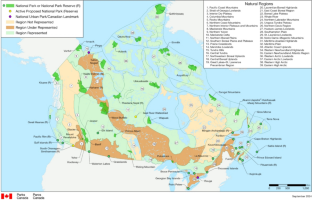
Abstract
While landscape connectivity is an important focus of Canada’s conservation goals, Canadian national parks are vulnerable to habitat loss, the breaking-up of habitat patches, and a reduction in their connectivity to surrounding ecosystems. This study measured landscape fragmentation in 43 Canadian national parks and control areas throughout their history, from before their designation to present-day. It used the effective mesh size metric to measure the divergence of fragmentation levels between the parks and their control areas, using a Progressive-Change Before-After Control-Impact Paired-Series study design. The results reveal that overall, park protection across the Canadian national park system has been somewhat unsuccessful in preventing landscape fragmentation within their boundaries, compared to unprotected control areas. Half of the parks and control areas showed only very small changes in fragmentation. However, in 35% of parks, fragmentation levels increased faster than in their control areas. In only 15% of parks, fragmentation levels increased more slowly than in control areas. Older parks with a long history of human influence have become more fragmented than their control areas. On average, park protection has prevented fragmentation most effectively in the Taiga and Prairies ecoregions (in FG1) and Pacific Maritime and Arctic ecoregions (in FG2), respectively. The findings provide insights into Canada’s efforts to achieve its conservation goals and can inform ecological connectivity protection and restoration. Monitoring of landscape fragmentation discloses trends over long time periods and relates them to Parks Canada’s various management strategies throughout the agency’s history and should be continued in the future.

