2026-06-16 中国科学院(CAS)
<関連情報>
- https://english.cas.cn/newsroom/research-news/202606/t20260616_1163637.shtml
- https://iopscience.iop.org/article/10.3847/1538-4365/ae644a
メソシデライトおよび輝石+金属混合物の分光反射特性(0.3~2.5μm ) Spectral Reflectance Properties (0.3–2.5 μm) of Mesosiderites and Pyroxene+Metal Mixtures
Pengyue Wang (王鹏越), Edward Cloutis, Ye Su (苏烨), Xian Shi (史弦), and Man-to Hui (许文韬)
The Astrophysical Journal Supplement Series Published: 2026 May 28
DOI:10.3847/1538-4365/ae644a
Abstract
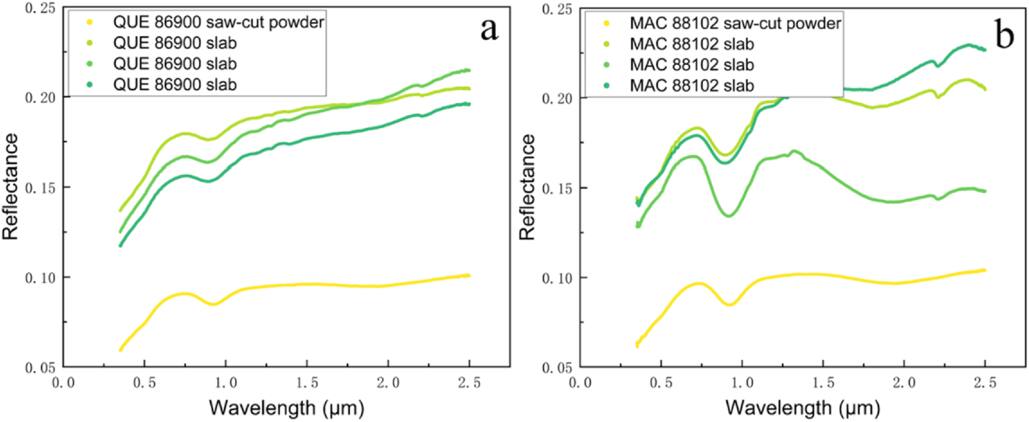
To date, the parent body of mesosiderites remains uncertain. Some candidate bodies have been proposed, including 4 Vesta and 16 Psyche. In this study, we performed a comprehensive spectroscopic survey of mesosiderites and pyroxene+metal mixtures to determine the factors that control their reflectance spectra in the 0.3–2.5 μm region and to help better identify possible parent bodies. We also applied these results to several well-known parent-body targets. We found that the mesosiderite powder and pyroxene powder on a metal slab both show significant differences in their spectra compared to Psyche. Although the spectra of the 10:90 orthopyroxene+metal powder was similar to that of Psyche, this does not necessarily mean that there is only a small amount (∼10%) of pyroxene on the surface of Psyche. Taking into account the density of Psyche, we infer that there might be a large amount of low-iron pyroxene on its surface. Looking in more detail at the spectral metrics, we note that some forms of some mesosiderites match some aspects of Psyche. Since some spectral metrics and ferrosilite content of howardites, diogenites, and mesosiderites are similar, the possibility of Vesta being a mesosiderite parent body cannot be ruled out either. However, the higher metal content of mesosiderites favors them, over howardites and diogenites, being linked to Psyche.