2026-06-16 中国科学院(CAS)
<関連情報>
- https://english.cas.cn/newsroom/research-news/202606/t20260616_1163636.shtml
- https://iopscience.iop.org/article/10.3847/1538-4357/ae5c08
ALMAを用いた巨大原始星団における原始星変動の追跡。I. QUARKSとMaMMOtHからの知見 Tracking Protostellar Variability in Massive Protoclusters with ALMA. I. Insights from QUARKS and MaMMOtH
Yuhan Yang, Tie Liu, Sheng-Yuan Liu, Doug Johnstone, Gregory Herczeg, Wenyu Jiao, Yu-Nung Su, Xiaofeng Mai, Fengwei Xu, D. M.-A. Meyer,…
The Astrophysical Journal Published: 2026 May 14
DOI:10.3847/1538-4357/ae5c08
Abstract
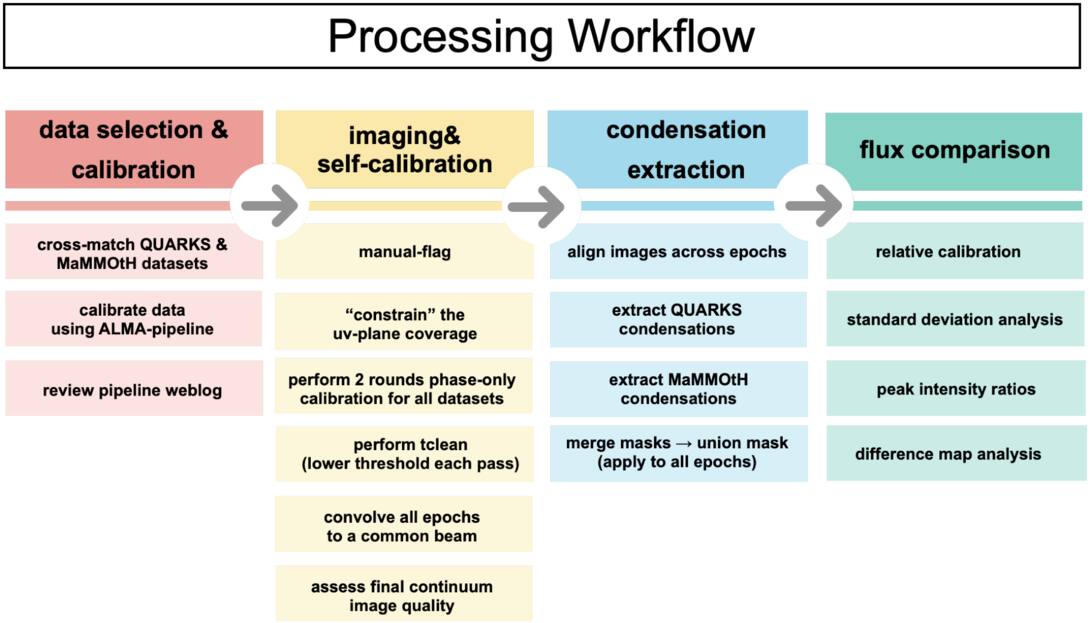
Millimeter/submillimeter variability is often attributed to dynamical disk-mediated accretion, yet detection is limited to low-mass protostars in nearby clouds. Recent observations have also revealed significant (sub)millimeter variability in high-mass protostars, but the confirmed cases are scarce and lack systematic monitoring. In this work, we analyzed multi-epoch Atacama Large Millimeter/submillimeter Array Band 6 (1.3 mm) continuum observations of 22 massive protoclusters, with epoch separations ranging from a few hours to more than 2 yr, while achieving a consistent angular resolution of ∼0”.3. These data allow us to track variability of protostars across a broader mass range and in an environment markedly different from nearby clouds. Using a custom processing pipeline of data reduction, image alignment, and relative flux calibration, we achieve high-precision flux measurements and, for the first time, investigate millimeter variability in massive protoclusters using interferometric data from a statistical point of view. Applying the astrodendro algorithm, we identified 383 condensations and tracked their variations in their peak intensities. Standard deviation analysis and difference maps reveal five variable sources, corresponding to a lower limit of 1.3% on the variable fraction. Among these, I13111-6228 stands out as it hosts a hypercompact H ii region that shows an increase of approximately 68% in continuum peak intensity over 1 yr, with an uncertainty of 2%.