2026-06-02 すばる望遠鏡
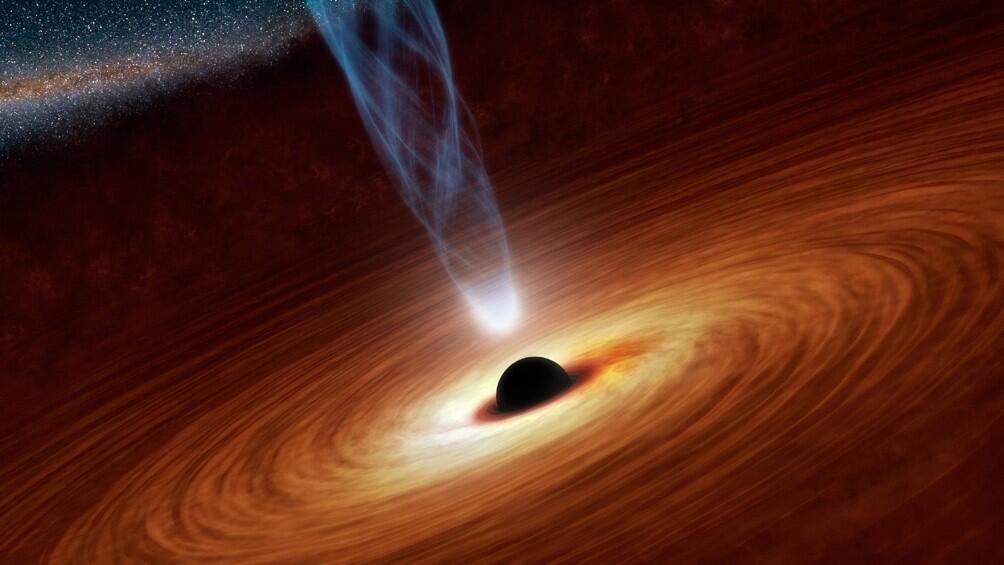
図1:超巨大ブラックホール周辺の想像図。銀河中心にあるブラックホールにガスが落ち込むと、周囲に高温のガス円盤ができ、強い光を放ちます。天体によっては電波ジェットを伴うこともあります。(クレジット:NASA/JPL-Caltech)
<関連情報>
- https://subarutelescope.org/jp/results/2026/06/02/3719.html
- https://iopscience.iop.org/article/10.3847/2041-8213/ae633b
黒体クエーサーおよび電波源(BBQSORS): T ∼ 10 4 Kの黒体スペクトルを持つ遷移型小赤色点の候補 Blackbody Quasar and Radio Source (BBQSORS): A Candidate of Transitional Little Red Dots with a T ∼ 104 K Blackbody Spectrum
Yuxing Zhong (仲宇星), Xiaoyang Chen, Kohei Ichikawa, Youwen Kong, Kentaro Aoki, Satoshi Yamada, Tohru Nagao, Daisaburo Kido, Toshihiro Kawaguchi, Yoshiki Matsuoka
The Astrophysical Journal Letters Published: 2026 June 2
DOI:10.3847/2041-8213/ae633b
Abstract
JWST surveys have identified a new class of active galactic nuclei (AGNs) called little red dots (LRDs). Their observational properties challenge the canonical AGN paradigm and provide key insights into the early growth phase of the supermassive black holes (SMBHs). We report Subaru/PFS spectroscopic follow-up of a radio-loud quasar at z = 1.715 from the UNVEIL radio AGN catalog, including X-ray detections. The spectrum displays broad C iii]λ1909 and Mg iiλ2800 emission lines with FWHM ≳4000 km s−1, accompanied by narrow absorption features. The spectrum reveals a characteristic Λ-shape over the rest-frame wavelength ranging ∼1500–3500 Å. The underlying continuum cannot be reproduced by simply applying dust extinction to typical unobscured quasars. Alternatively, it is well described by a blackbody spectrum with a temperature of T ∼ 104 K. This result agrees well with its UV to MIR photometry, which can be well modeled by three blackbody components representing the BH envelope (T ≈ 9700 K), dust torus (T ≈ 1500 K), and host galaxy dust (T ∼ 80 K). The source is marginally detected in the GALEX NUV, revealing a potential V-shaped spectral energy distribution around 1400 Å, reminiscent of the spectral feature reported for LRDs whose V-shapes occur around 3000–4000 Å. This wavelength shift is broadly consistent with the temperature contrast between our blackbody component (T ∼ 104 K) and the lower effective temperature of T ∼ 5000 K expected for the BH envelope of LRDs. These properties suggest that this source might be caught in an evolutionary phase in which the dense gas envelope characteristic of LRD has begun to fragment, allowing us to witness the emergence of a quasar from an LRD-like state.