

2026-05-18 ローレンスバークレー国立研究所(LBNL)
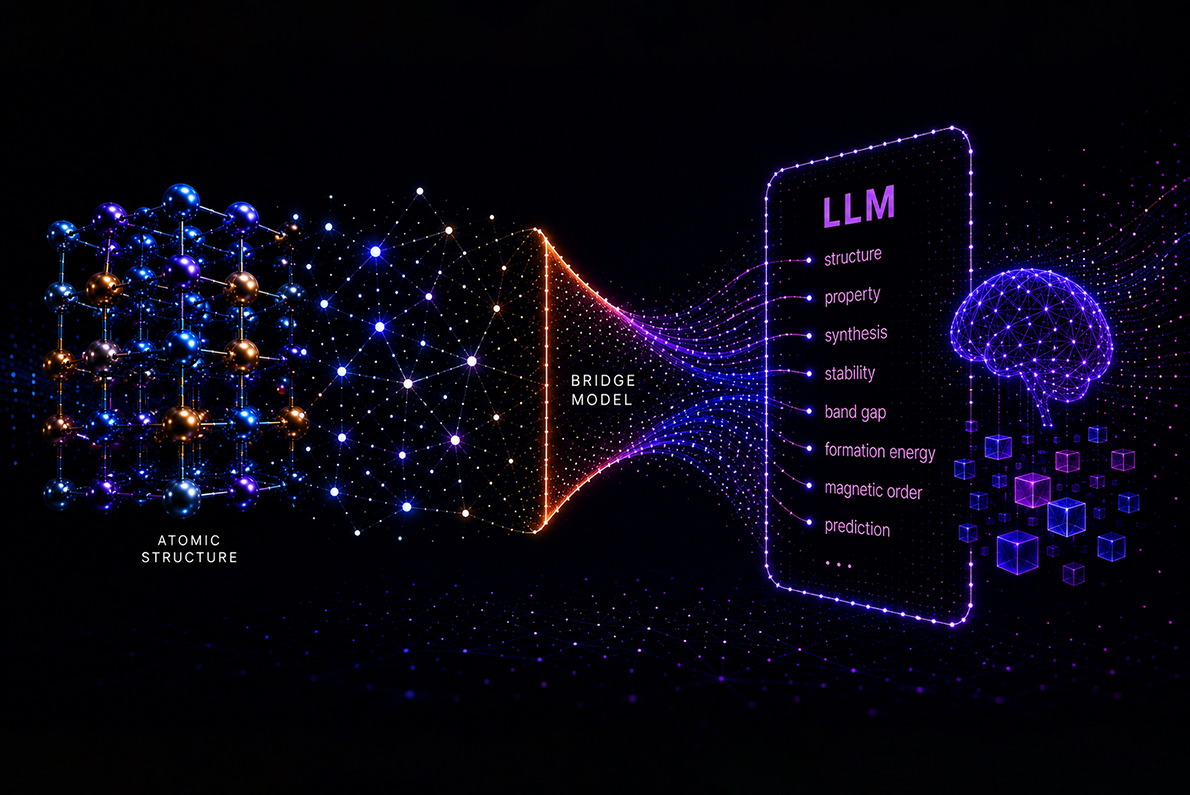
MatterChat serves as a specialized bridge, helping text-based AI understand the complex 3D forces between atoms, turning it into a powerful tool for discovering new materials. (Credit: Yingheng Tang/Zhi Jackie Yao/Berkeley Lab)
<関連情報>
- https://newscenter.lbl.gov/2026/05/18/new-matterchat-model-helps-ai-to-see-the-language-of-science/
- https://www.nature.com/articles/s42256-026-01214-y
材料科学のためのマルチモーダル大規模言語モデル A multimodal large language model for materials science
Yingheng Tang,Wenbin Xu,Jie Cao,Weilu Gao,Steven Farrell,Benjamin Erichson,Michael W. Mahoney,Andy Nonaka & Zhi Jackie Yao
Nature Machin Intelligence Published:24 April 2026
DOI:https://doi.org/10.1038/s42256-026-01214-y
Abstract
Understanding and predicting the properties of inorganic materials is crucial for accelerating advancements in materials science and driving applications in energy, electronics and beyond. Integrating material structure data with language-based information through multimodal large language models (LLMs) offers great potential to support these efforts by enhancing human–artificial intelligence interaction. However, a key challenge lies in integrating atomic structures at full resolution into LLMs. In this work, we introduce MatterChat, a versatile structure-aware multimodal LLM that unifies material structural data and textual inputs into a single cohesive model. MatterChat uses a bridging module to effectively align a pretrained universal machine learning interatomic potential with a pretrained LLM, reducing training costs and enhancing flexibility. Our results demonstrate that MatterChat greatly improves performance in material property prediction and human–artificial intelligence interaction, surpassing general-purpose LLMs such as GPT-4. We also demonstrate its usefulness in applications such as more advanced scientific reasoning and step-by-step material synthesis.

