2026-04-23 日本原子力研究機構,東京大学生産技術研究所,ファインセラミックスセンター
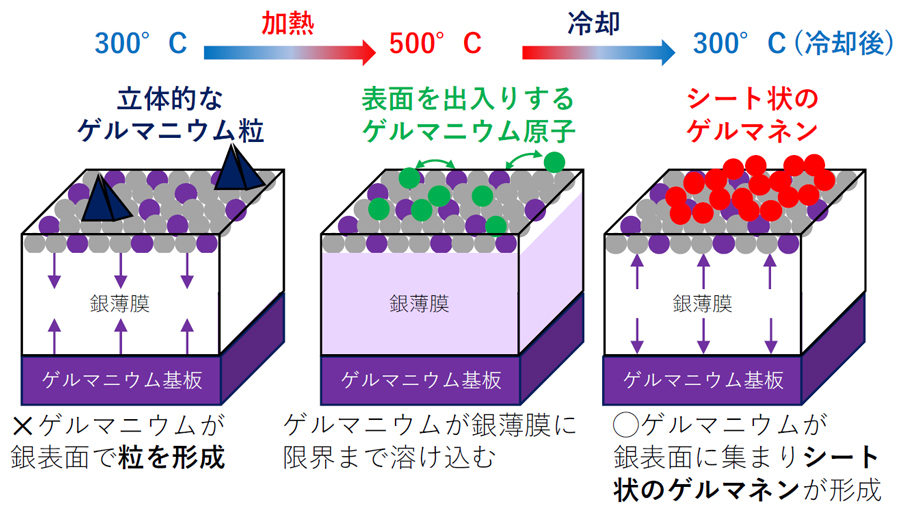
図1ゲルマニウム原子が表面に集まりゲルマネンを形成する流れ(概念図)
<関連情報>
- https://www.jaea.go.jp/02/press2026/p26042301/
- https://pubs.acs.org/doi/10.1021/acs.chemmater.5c03462
銀薄膜を通した偏析によるゲルマネン形成を、ラマン分光とXPSでその場追跡 In Situ Study of Growth Mechanism of Germanene Segregated through Ag(111) Thin Films by Raman and X-ray Photoelectron Spectroscopy
Tomo-o Terasawa,Daiki Katsube,Masahiro Yano,Takahiro Ozawa,Yasutaka Tsuda,Akitaka Yoshigoe,Hidehito Asaoka,and Seiya Suzuki
Chemistry of Materials Published: March 10, 2026
DOI:https://doi.org/10.1021/acs.chemmater.5c03462
Abstract
Germanene, a honeycomb lattice of Ge atoms, has attracted attention for next-generation electronics and as a topological material. Among reported synthesis routes, the segregation method enables reproducible monolayer germanene formation on Ag(111) through simply annealing an Ag(111) thin film on a Ge(111) substrate. Despite this success, the physical origins of its monolayer selectivity and the mechanism for suppressing competing Ge phases remain unclear. Here, we investigate germanene formation via Ge segregation using in situ Raman spectroscopy and X-ray photoelectron spectroscopy to directly track Ge behavior during annealing and cooling. In situ observations revealed that annealing at 500 °C yielded no Ge-related byproducts, and the system reached a high-temperature surface equilibrium state, independent of the initial Ge amount. Cooling from this state produced a Ge-enriched surface that stabilizes the formation of monolayer germanene. In contrast, heating only to 300 °C produced three-dimensional Ge islands without Ge enrichment, followed by Ge–Ag alloy formation upon subsequent cooling. By integrating the temperature-dependent diffusion length and the process-dependent diffusion direction, we established a unified description of Ge behavior on Ag/Ge(111) substrates, in which cooling-induced Ge enrichment at the surface reproducibly stabilizes the selective formation of monolayer germanene.