20026-04-23 豊橋技術科学大学
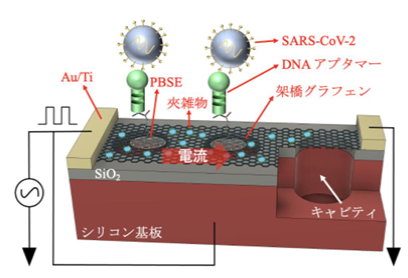
質量・粒子数を同時に計測する電流駆動型グラフェン共振センサ
<関連情報>
- https://www.tut.ac.jp/news/260423-23926.html
- https://www.tut.ac.jp/docs/PR20260423.pdf
- https://www.sciencedirect.com/science/article/pii/S0925400526005022
電気熱駆動型グラフェン共振センサーを用いた分子量と粒子数のマルチモーダル検出 Multimodal detection of molecular mass and particle number using an electrothermally driven graphene resonant sensor
Viet Khoa Pham, Homare Yoshida, Sachiko Sakai, Ippei Akita, Yuki Imaizumi, Tatsuro Goda, Yong-Joon Choi, Toshihiko Noda, Kazuaki Sawada, Kazuhiro Takahashi
Sensors and Actuators B: Chemical Available online: 6 April 2026
DOI:https://doi.org/10.1016/j.snb.2026.139924
Highlights
- A multimodal graphene resonant sensor enables simultaneous measurement of mass and particle number.
- Dual-readout overcomes non-specific adsorption and impurity interference.
- Silica nanoparticles were detected with a sensitivity of 6.241.83 zg Hz−1.
- Detected SARS-CoV-2 viruses from high-concentration impurity proteins.
Abstract
Label-free virus detection offers the potential for real-time, unmodified sensing, but faces a critical challenge: impurity-induced non-specific adsorption produces signals indistinguishable from those generated by target viruses. To address this issue, we propose a multimodal measurement approach employing an electrothermally driven graphene resonant sensor that simultaneously quantifies molecular mass and particle number. By monitoring changes in resonance amplitude (or graphene channel impedance) upon molecular adsorption, the method enables robust particle counting, thereby facilitating separation of the mass response of target viral molecules from the confounding signals caused by non-specifically adsorbed impurities. The multimodal approach was validated using amine-functionalized silica nanoparticles with diameters of 100 and 10 nm to model viruses and impurities, respectively. The sensor exhibited distinct resonance behaviors depending on nanoparticle concentration and mass. With a chemically functionalized surface, the sensor achieved an experimental mass sensitivity of 6.24 ± 1.83 zg Hz−1. Furthermore, detection of inactivated SARS-CoV-2 whole virus in the presence of protein contaminants was demonstrated, with resonance behavior consistent with nanoparticle models. This study highlights the potential of our proposed approach to improve the selectivity and accuracy of label-free mass sensors, enabling robust and more reliable virus detection in real-world, impurity-laden environments.