2026-04-21 イェール大学
<関連情報>
- https://news.yale.edu/2026/04/21/deep-rooted-grass-stores-significantly-more-carbon-new-study-says
- https://agupubs.onlinelibrary.wiley.com/doi/10.1029/2025EF007102
耕作地における深根性草が地下炭素貯蔵に及ぼす影響の評価:米国複数地点調査からの知見 Assessing the Effect of a Deep-Rooted Grass on Belowground Carbon Storage in Cultivated Land: Insights From a Multi-Site US Study
Eric W. Slessarev, Jennifer Pett-Ridge, Kyungjin Min, Asmeret Asefaw Berhe, Srabani Das, Randall D. Jackson, Julie D. Jastrow, Megan Kan, Sandeep Kumar, …
Earth’s Future Published: 30 March 2026
DOI:https://doi.org/10.1029/2025EF007102
Abstract
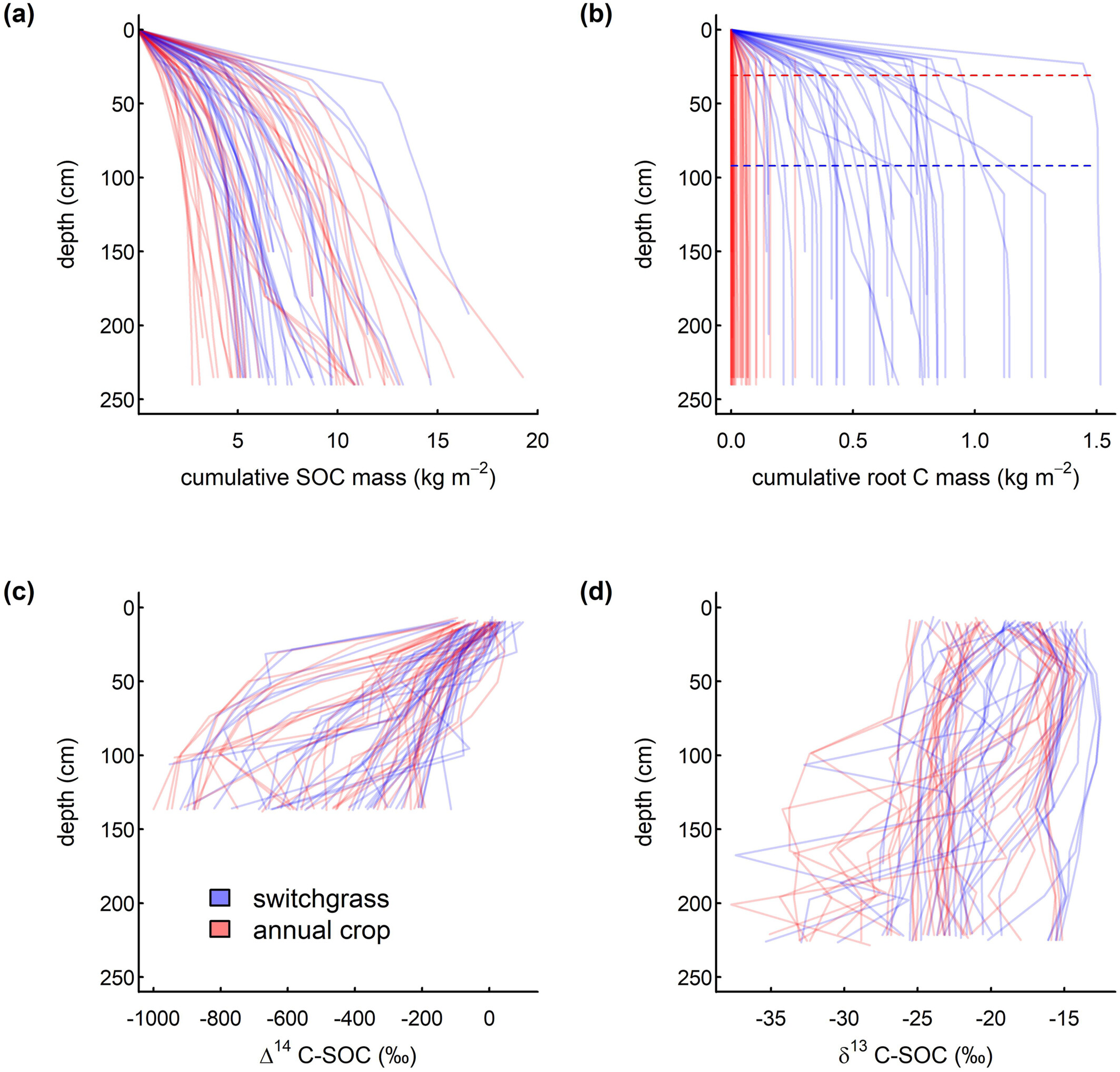
Agriculture depletes soil organic carbon (SOC), partly due to the exclusion of deep-rooted perennials. Reintroducing deep-rooted perennials to cultivated land may help to mitigate SOC loss. We quantified the effect of deep roots on SOC by comparing 8 to 30 year-old stands of switchgrass (Panicum virgatum L.) with paired annual row crop fields at 12 sites across the central and eastern USA. We hypothesized that switchgrass would store more root C and SOC than neighboring shallow-rooted annual crops, and that these effects would extend deeper than 30 cm. We also evaluated whether switchgrass stimulates decomposition of SOC at depth using radiocarbon (14C). Finally, we explored whether the effect of switchgrass on SOC is moderated by soil chemical and physical properties. While the effect of switchgrass on SOC in the surface 100 cm was positive at most sites, the average effect was not statistically significant (difference in SOC = 0.6 kg C m−2 [95% CI −0.8 to +1.9 kg C m−2]). By contrast, we found that root C was consistently more abundant under switchgrass, yielding an estimated additional 0.6 kg C m−2 in the surface 100 cm of soil [95% CI +0.5 to +0.7 kg C m−2]. 14C measurements suggested that root C inputs were adding to existing SOC without stimulating decomposition. The effect of switchgrass on belowground C was not strongly related to any of the soil properties that we evaluated. Our observations show that root C can contribute substantially to belowground C stocks when deep-rooted perennials replace shallow-rooted crops.
Plain Language Summary
Planting deep-rooted perennial plants in former croplands has been proposed as a strategy for sequestering organic carbon in soil. Deep-rooted plants are thought to store more organic carbon in soil than shallow-rooted plants because root biomass stores carbon and helps to build soil organic matter over time. We tested this hypothesis by studying switchgrass, a deep-rooted perennial, at 12 sites across the USA where it had been planted and maintained for 8–30 years. We found that switchgrass consistently stores more carbon than annual crops plants in its root biomass, but that its effects on carbon storage in soil organic matter were not statistically detectable. Radiocarbon measurements suggested that switchgrass was adding newly fixed carbon deep in the soil without necessarily stimulating loss of older soil organic matter. Our study shows that switchgrass can increase belowground carbon storage, and that it does this primarily by growing deep roots.