2026-04-09 自然科学研究機構
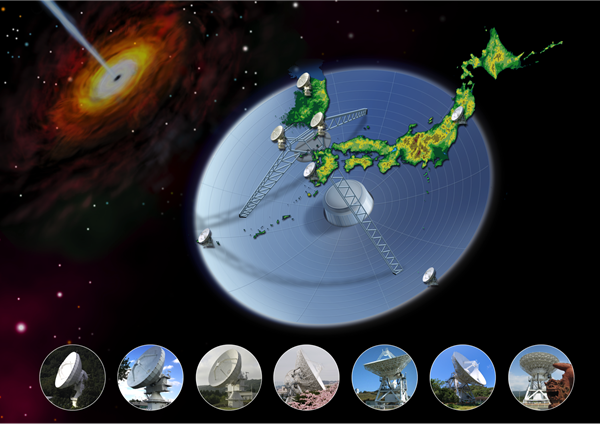
【図1】日韓合同VLBI観測網(The KVN and VERA Array, 通称KaVA)。下は本観測に参加した各観測局で、左からKVNのヨンセイ局(ソウル)、ウルサン局、タムナ局(済州)、VERA水沢局、入来局、小笠原局、石垣局にある電波望遠鏡の写真。
<関連情報>
- https://www.miz.nao.ac.jp/veraserver/news/reports/20260409_M87wave/index.html
- https://iopscience.iop.org/article/10.3847/1538-4357/ae355b
磁気支配型M87ジェットにおける横方向振動と波動伝播 Transverse Oscillations and Wave Propagation in the Magnetically Dominated M87 Jet
Hyunwook Ro, Motoki Kino, Kazuhiro Hada, Yosuke Mizuno, Yuzhu Cui, Kunwoo Yi, Tomohisa Kawashima, Jongho Park, and Bong Won Sohn
The Astrophysical Journal Published: 2026 March 2
DOI:10.3847/1538-4357/ae355b
Abstract
We present an in-depth analysis of the transverse oscillations in the M87 jet, as identified in our previous study, which reported oscillatory patterns with a characteristic period of ∼1 yr in the edge-brightened jet structure extending up to 12 mas from the core. This work is based on high-cadence KaVA 22 GHz observations conducted from 2013 December to 2016 June. By analyzing the transverse velocity profiles and the spatial evolution of the oscillations, we find that the oscillations propagate downstream along the jet, with a wavelength of ∼9–10 mas. A single-mode sinusoidal wave model applied to the ridgelines successfully reproduces the observed transverse oscillations and yields superluminal wave speeds of ∼2.7–2.9c, consistent with the bulk jet velocity in this region. These findings suggest that the transverse oscillations may be interpreted either as transverse MHD waves—possibly excited by jet precession, nutation, or quasiperiodic magnetic flux eruptions near the central engine—or as manifestations of jet instabilities, such as current-driven instabilities. Further investigation is required to distinguish between these scenarios and to clarify the dominant physical mechanism.