2026-04-09 愛媛大学
<関連情報>
- https://www.ehime-u.ac.jp/data_relese/pr_20260409_grc/
- https://www.ehime-u.ac.jp/wp-content/uploads/2026/04/pr_20260331_grc-2.pdf
- https://www.science.org/doi/10.1126/sciadv.adu5181
カンラン石の準無拡散相転移によって起きる深部断層すべりを放射光その場観察実験によって再現 Faulting triggered by a quasi-diffusionless shear transition of olivine in deep subducted slabs
Kohei Matsuda, Tomohiro Ohuchi, Sayako Inoué, Yuji Higo, […] , and Takeshi Sakai
Science Advances Published:8 Apr 2026
DOI:https://doi.org/10.1126/sciadv.adu5181
Abstract
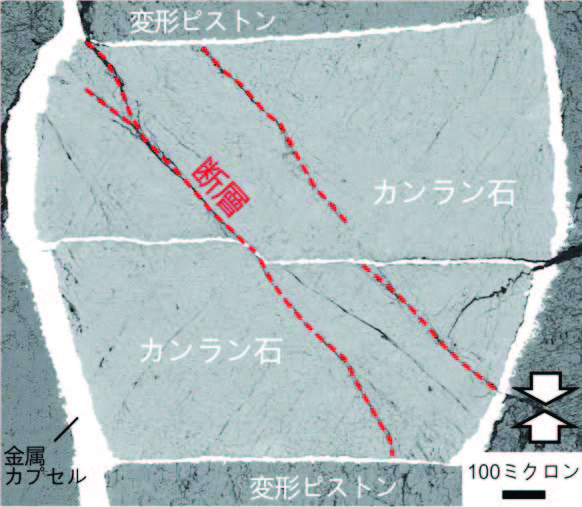
To clarify the process of faulting triggered by the olivine-ringwoodite transition in deep subducted slabs, we conducted deformation experiments on mantle olivine at pressures of 15 to 20 gigapascals and temperatures of 870 to 1320 kelvins. Throughgoing faulting occurred as a result of shear localization to “soft” gouge layers, which mainly consist of kinked olivine grains. Kinking of olivine grains on the [010](100) slip system resulted in a pseudo-martensitic transition of olivine to ringwoodite via poirierite having relationships of [010]Ol // [010]Poi and [100]Ol // [101]Poi. The release of a high amount of latent heat via the poirierite-ringwoodite transition can induce a significant weakening of the fault gouge, without the aid of grain size–sensitive creep, resulting in the occurrence of faulting. The observed pseudo-martensitic transition of olivine to ringwoodite, which can proceed even at room temperature under stress, explains the cause of high seismicity in bending regions of cold subducted slabs that consist of metastable olivine.