2026-04-09 国際農林水産業研究センター,フィリピン稲研究所
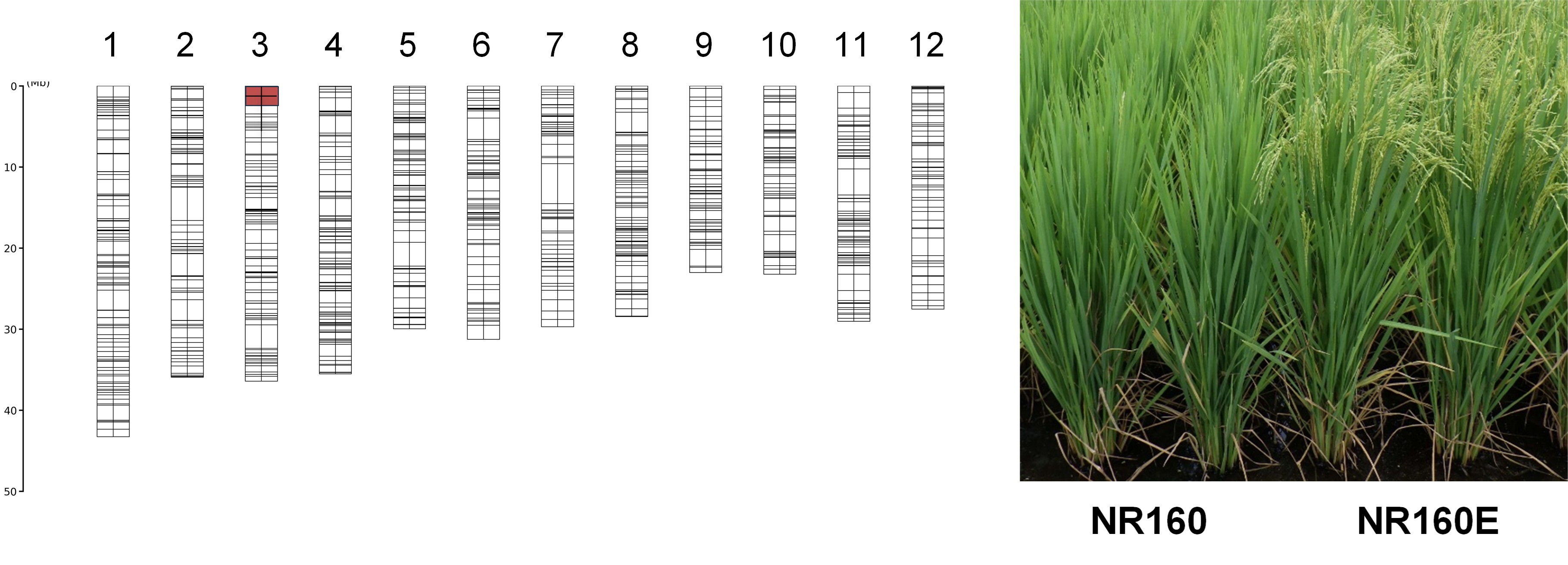
図1 早生高収量系統NR160Eの遺伝子型と草姿の特徴
<関連情報>
- https://www.jircas.go.jp/ja/release/2026/press202601
- https://onlinelibrary.wiley.com/doi/10.1002/pld3.70160
インディカ高収量品種NSIC Rc 160由来の早生出穂米系統の開発と評価 Development and Evaluation of an Early Heading Rice Line From the Indica High-Yielding Variety NSIC Rc 160
Kazuhiro Sasaki, Hiroki Saito, Teodora E. Mananghaya, Jonathan M. Niones, Mitsuhiro Obara
Plant Direct Published: 27 March 2026
DOI:https://doi.org/10.1002/pld3.70160
ABSTRACT
To reduce the environmental burden associated with excessive nitrogen fertilizer use in rice cultivation, we developed NR160E, an early heading isogenic line derived from the high-yielding variety NSIC Rc 160 (NR160). Although early heading is often considered unfavorable for yield and excluded from high-yield breeding programs, our results challenge this assumption. In field trials conducted under natural long-day conditions in Tsukuba, Japan (planting density of 18.5 plants m−2), heading occurred ~8–10 days earlier in NR160E than in NR160 across all nitrogen fertilization levels (0, 4.8, and 9.6 g N m−2). In NR160E, early heading was associated with reduced plant height and a marked increase in harvest index (HI). Specifically, plant height decreased by ~15%, whereas HI increased by 20% compared with NR160, indicating efficient biomass partitioning and suggesting its potential within this genetic and environmental context. Fine-mapping identified a 33.3-kbp region on chromosome 3 containing four annotated genes (Os03G0122600, Os03g0123100, Os03g0123200, and Os03g0123300) among which OsMADS50 (Os03G0122600) was upregulated in NR160E under long-day conditions, accompanied by elevated Ehd1 and RFT1 expression, consistent with the early heading phenotype. Photoperiod experiments revealed that heading occurred significantly earlier in NR160E than in NR160 under long-day conditions (13.0–14.5 h), whereas no significant difference was observed under short-day conditions (10.0–11.5 h), indicating that the expression of early heading in NR160E depends strongly on photoperiodic conditions. Field trials across 12 cultivation regimes varying in nitrogen input and planting density consistently showed that NR160E outperformed NR160 in grain yield. At 18.5 plants m−2, NR160E produced grain yields of 649.0, 797.7, and 922.9 g m−2 under 0-, 4.8-, and 9.6-g N m−2 fertilization, respectively, whereas NR160 yielded 513.0, 666.4, and 692.3 g m−2 under the same conditions. Within each nitrogen–field condition, NR160E produced higher yield than NR160. Seed fertility was consistently higher in NR160E across nitrogen–field conditions (e.g., 0.815 under zero nitrogen input), and NR160E also exhibited a consistently higher agronomical HI, consistent with more efficient assimilate allocation to grain. Growth analysis showed that NR160E maintained dry matter production during grain filling, coinciding with its higher HI and physiological nitrogen-use efficiency. Although these relationships are observational and the physiological basis remains unclear, the trend was consistent across conditions. Regression analysis also revealed a steeper slope between nitrogen uptake and grain yield in NR160E than in NR160, consistent with higher physiological nitrogen-use efficiency (as defined in this study). Collectively, these results suggest that earlier heading may be associated with sustained productivity under the long-day field conditions examined here. However, determining how this trait could inform fertilizer management or nitrogen-input strategies will require multienvironment and multibackground validation.