2026-04-08 オークリッジ国立研究所(ORNL)
<関連情報>
- https://www.ornl.gov/news/molten-salt-chemistry-converts-consumer-polymer-fuel
- https://pubs.acs.org/doi/10.1021/jacs.5c01107
溶融塩中におけるポリエチレンの液体アルカンへのアップサイクル(無水素および外部水素源フリー条件下) Polyethylene Upcycling to Liquid Alkanes in Molten Salts under Neat and External Hydrogen Source-Free Conditions
Liqi Qiu,Felipe Polo-Garzon,Luke L. Daemen,Min-Jae Kim,Jinghua Guo,Bobby G. Sumpter,Michael R. Koehler,Carlos Alberto Steren,Tao Wang,Logan T Kearney,Tomonori Saito,Zhenzhen Yang,and Sheng Dai
Journal of the American Chemical Society Published: April 7, 2025
DOI:https://doi.org/10.1021/jacs.5c01107
Abstract
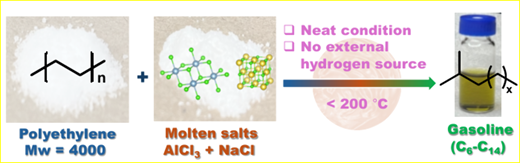
Development of facile approaches to convert plastic waste into liquid fuels under neat conditions is highly desired but challenging, particularly without noble metal catalysts and an external hydrogen source. Herein, highly efficient and selective polyethylene-to-gasoline oil (branched C6–C12 alkanes) conversion was achieved under mild conditions (<170 °C) using commercially available AlCl3-containing molten salts as reaction media and to provide catalytic sites (no extra solvents, additives, or hydrogen feeding). The high catalytic efficiency and selectivity was ensured by the abundant active Al sites with strong Lewis acidity (comparable to the Al type in acidic zeolite) and highly ionic nature of the molten salts to stabilize the carbenium intermediates. Dynamic genesis of the Al sites was elucidated via time-resolved Al K-edge soft X-ray and 27Al NMR, confirming the tricoordinated Al3+ as active sites and its coordination with the as-generated alkene/aromatic intermediates. The carbenium formation and polyethylene chain variation was illustrated by inelastic neutron scattering (INS) and an isotope-labeling experiment. Theoretical simulations further demonstrated the successive hydride abstraction, β-scission, isomerization, and internal hydrogen transfer reaction pathway with AlCl3 as active sites. This facile catalytic system can further achieve the conversion of robust, densely assembled, and high molecular weight plastic model compounds to liquid alkane products in the diesel range.