2026-03-26 大阪大学
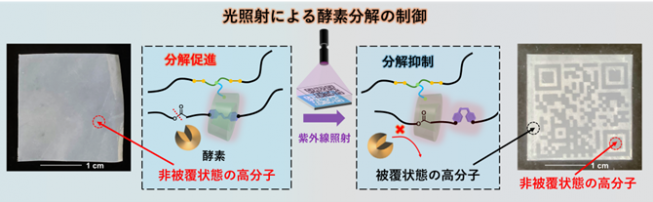
光照射による酵素分解の制御と局所的な光照射によるパターン生成
<関連情報>
- https://www.sci.osaka-u.ac.jp/ja/topics/16484/
- https://www.sci.osaka-u.ac.jp/ja/wp-content/uploads/2020/08/pr_takashima202603-1.pdf
- https://pubs.acs.org/doi/10.1021/acsnano.5c19646
光制御可能なポリエステルネットワークと可動式架橋構造によるオンデマンド酵素分解 Light-Programmable Polyester Networks with Movable Cross-Links for On-Demand Enzymatic Degradation
Xin Zhou,Jiaxiong Liu,Kenji Yamaoka,Ryohei Ikura,Akihide Sugawara,Go Matsuba,Hiroshi Uyama,and Yoshinori Takashima
ACS Nano Published: March 25, 2026
DOI:https://doi.org/10.1021/acsnano.5c19646
Abstract
The design of sustainable materials that integrates mechanical toughness with on-demand degradability remains a central challenge in the development of materials science. Here, we present a photoresponsive polyester capable of light-regulated enzymatic degradation through movable cross-links. The material consists of a poly(ε-caprolactone) backbone and inclusion complexes between photoisomerizable trans-stilbene (tSti) units and triacetylated γ-cyclodextrin (TAcγCD) units. Upon UV-A (λ = 350 nm) or UV-C (λ = 254 nm) irradiation, stilbene units undergo reversible trans–cis isomerization, repositioning cyclodextrin (CD) rings along the backbone and thereby switching the molecular coverage of enzyme-active ester groups. In the trans state, polyester segments are exposed, accelerating lipase-catalyzed degradation; in the cis state, ester groups are shielded, suppressing degradation. The switching is reversible under alternating UV-A/UV-C irradiation and absent in the linear control lacking movable rings, demonstrating that controllable CD positioning is essential for degradation control. This study introduces a molecular-coverage-based design rule that reconciles toughness and degradability for sustainable, environmentally benign polymers.