2026-03-02 中国科学院(CAS)
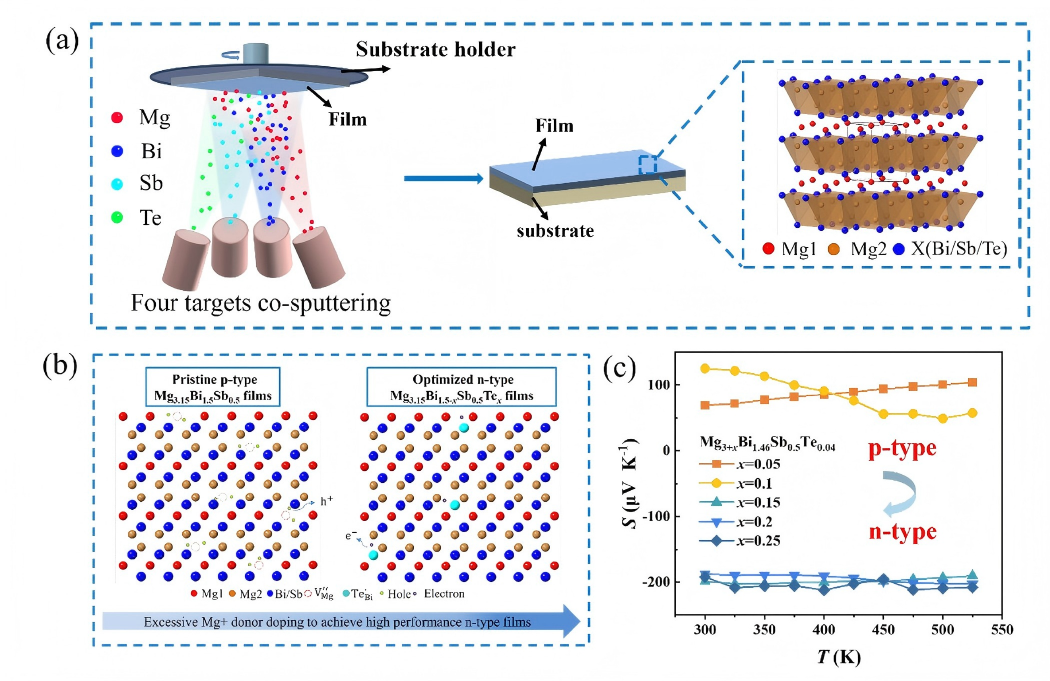
Schematic illustration of the fabrication process for n-type Mg3(Sb, Bi)2 thin films and the mechanism of p-type to n-type transition. (Image by IMR)
<関連情報>
- https://english.cas.cn/newsroom/research-news/202603/t20260302_1151351.shtml
- https://www.sciencedirect.com/science/article/abs/pii/S1359645426001187
二重欠陥工学によりn型Mg3Bi1.5Sb0.5薄膜の熱電性能を向上 Dual-defect engineering enables enhanced thermoelectric performance in n-type Mg3Bi1.5Sb0.5 thin films
Yijun Ran, Wenxue Ma, Wenxia Li, Shengqian Li, Xiaoyang Wang, Ting Xiong, Dayi Zhou, Xiangshan Kong, Ning Gao, Zhi Yu, Kaiping Tai
Acta Materialia Available online: 11 February 2026
DOI:https://doi.org/10.1016/j.actamat.2026.122012
Abstract
Mg3(Sb, Bi)2-based thin films have garnered significant attention from researchers due to their promising thermoelectric properties and low raw material costs. However, Mg evaporation during high temperature deposition impedes the optimization of carrier concentration, limiting further thermoelectric performance elevation. Here, we demonstrate a breakthrough in thermoelectric performance of n-type Mg3.15Bi1.46Sb0.5Te0.04 thin films through dual-defect engineering, synergistically controlling Mg vacancy and introducing Te dopants. Regulating the Mg-rich deposition atmosphere effectively suppresses Mg vacancy formation to enable efficient n-type doping. Concurrently, Te doping optimizes carrier concentration and induces heterogeneous lattice stress that suppresses thermal conductivity by enhancing phonon scattering. As a result, a peak ZT of 0.47 is obtained for the n-type Mg3.15Bi1.46Sb0.5Te0.04 thin film at 525 K, which ranks as the top of the Mg-based thin film materials. Integrating these optimized films into all-Mg3(Sb, Bi)2 devices (3-pair π-type structure) yields an output voltage (V) of ∼ 79 mV and power density (ω) of ∼ 1185 μW cm-2 at a temperature difference (ΔT) of 120 K. This work establishes dual-defect engineering strategy as a universal design principle for thin-film thermoelectric materials, bridging the critical performance gap between bulk and film systems for mid-temperature (400–600 K) waste heat energy harvesting applications.