
2026-04-27 イリノイ大学アーバナ・シャンペーン校
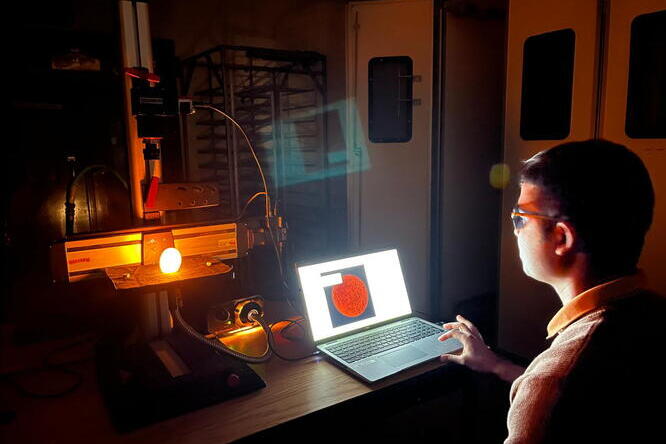
Md. Wadud Ahmed, doctoral student at the University of Illinois Urbana-Champaign, collects hyperspectral images of eggs.
<関連情報>
- https://aces.illinois.edu/news/illinois-researchers-determine-chick-sex-mortality-chicken-eggs-hatching
- https://www.tandfonline.com/doi/full/10.1080/00071668.2026.2620615
- https://www.sciencedirect.com/science/article/pii/S0956713525001021
ハイパースペクトルイメージングと説明可能な人工知能を用いた、孵化前および孵化初期におけるニワトリ胚の非破壊的死亡率予測 Non-destructive chick embryo mortality prediction at pre-incubation and early incubation using hyperspectral imaging and explainable artificial intelligence
M. W. Ahmed,J. L. Emmert & M. Kamruzzaman
British Poultry Science Published:20 Feb 2026
DOI:https://doi.org/10.1080/00071668.2026.2620615
ABSTRACT
1. This study evaluated the potential of visible-near infrared (Vis-NIR) hyperspectral imaging (HSI) combined with machine learning and explainable artificial intelligence (AI) to non-destructively predict chick embryo mortality before incubation and at 4 d of incubation.
2. The partial least squares discriminant analysis (PLS-DA), random forest (RF) and categorical boosting (CatBoost) calibration models were developed and independent validation and test sets evaluated the performance of the calibration models. In addition to raw figures, synthetic data was utilised for classification model development. Various spectral pre-processing and feature selection methods were evaluated to enhance predictive robustness. The best model was interpreted using Shapley additive explanations (SHAP) for AI.
3. At full wavelength (501–921 nm), the PLS-DA model demonstrated the best performance for chick embryo mortality classification, achieving an accuracy of 91.3% for calibration, 88% for validation and 86.7% for the test set for pre-incubation. At d 4 of incubation (ED4), the model showed 97.3% accuracy for calibration, 96% for validation and 97.3% for the test set, highlighting its robustness across different data sets.
4. The PLS-DA models, using a reduced set of important spectral features, demonstrated strong predictive performance, offering computational efficiency, robustness and enhanced interpretability.
5. The SHAP explainable AI revealed that wavelengths associated with embryo hydration status, blood formation and metabolic differences between live and dead embryos are critical for classifying chick embryo mortality during early incubation.
ハイパースペクトルイメージングと機械学習を用いた鶏卵の非破壊的な孵化前性別判定 Non-destructive pre-incubation sex determination in chicken eggs using hyperspectral imaging and machine learning
Md Wadud Ahmed, Asher Sprigler, Jason Lee Emmert, Mohammed Kamruzzaman
Food Control Available online: 15 February 2025
DOI:https://doi.org/10.1016/j.foodcont.2025.111233
Highlights
- Hyperspectral imaging was applied to predict pre-incubated egg sex.
- Data splitting, spectral pre-processing, and feature selection methods were explored.
- The CatBoost model showed the highest validation accuracy (83%).
- Synthetic data further ensures the robustness of the prediction model.
Abstract
Non-destructive sex determination in eggs can enhance animal welfare, improve economic efficiency, reduce environmental impact, and foster technological innovation in sustainable hatchery operations. This study investigates the effectiveness of non-destructive hyperspectral imaging (HSI) and machine learning for pre-incubation sex prediction in chicken eggs. Multiple classification models such as partial least squares discriminant analysis (PLS-DA), Extreme Gradient Boosting (XGBoost), random forest (RF), and Categorical Boosting (CatBoost) were developed across full wavelengths (452–899 nm) and evaluated through external validation. Multiple spectral pre-processing, such as standard normal variate (SNV), multiplicative scatter correction (MSC), and Savitzky-Golay (SG) were assessed for calibration model development. Further, important feature selection and model optimization techniques were evaluated for robust prediction model development. Using 35 important features, the CatBoost model with SG pre-processed spectra achieved the best performance, with an accuracy of 82.9% on the calibration set and 75.5% on the validation set. The study demonstrated the potential of HSI and advanced machine learning to revolutionize sex prediction in chicken eggs before incubation, offering a non-invasive, precise, and efficient solution for the next-generation poultry industry.

