2026-01-21 中国科学院(CAS)
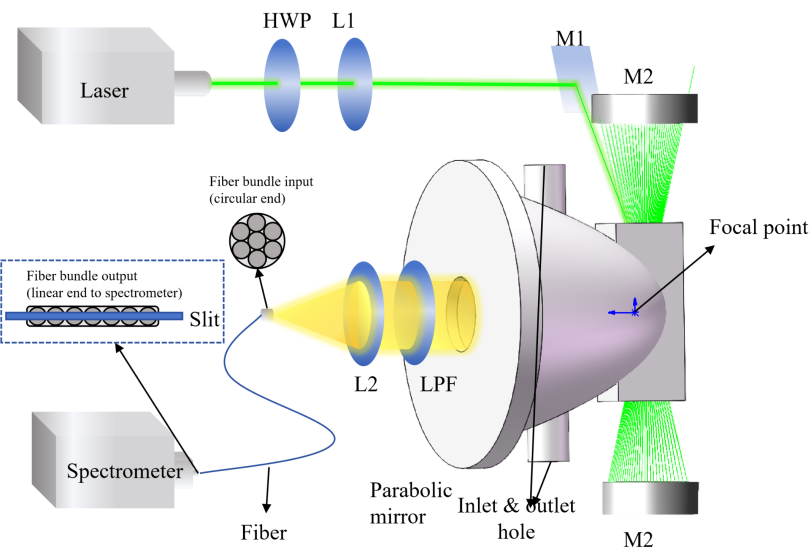
Schematic diagram of the O-PMCERS system (Image by LI Zhengang)
<関連情報>
- https://english.cas.cn/newsroom/research-news/202602/t20260213_1150963.shtml
- https://www.sciencedirect.com/science/article/abs/pii/S0030399225021450
高感度微量ガス検出のための最適化された放物面鏡共振器増強ラマン分光法 Optimized parabolic mirror cavity-enhanced Raman spectroscopy for high-sensitivity trace gas detection
Junfang Miao, Jiaxiang Liu, Xin Yu, Ganshang Si, Zhiqiang Ning, Haichun Xu, Canlong Wang, Ying Pan, Zhengang Li, Yonghua Fang
Optics & Laser Technology Available online: 21 December 2025
DOI:https://doi.org/10.1016/j.optlastec.2025.114554
Highlights
- Analyzed Raman scattering angular distribution in multi-beam cavity for optimal design.
- Designed parabolic mirror system to capture high-intensity scattering, boosting efficiency.
- Optimized O-PMCERS optical path design for compact, ∼2.7-fold volume reduction.
- Developed robust CWT-NLS algorithm for effective weak signal extraction from noise.
Abstract
Conventional trace gases detection techniques often lack selectivity, environmental robustness, or detection sensitivity. Raman spectroscopy, though capable of analyzing homonuclear diatomic molecules, is limited by its inherently weak signal intensity (due to a small scattering cross-section), impeding accurate gas concentration measurements. This study optimizes a parabolic mirror’s geometry and relative orientation based on an analysis of the Raman scattering angular intensity distribution within a near-concentric cavity. This optimization resulted in an efficient optical collection pathway, effectively eliminating signal collection blind spots and suppressing Rayleigh scattering noise. The Optimized Parabolic Mirror Cavity-Enhanced Raman Spectroscopy (O-PMCERS) system exhibited a substantial enhancement in signal intensity, yielding nearly a 7.6-fold increase relative to a near-concentric cavity and approximately a 28 % improvement compared with its conventional PMCERS counterpart. Concurrently, the signal-to-noise ratio (SNR) improved by factors of 11.4 and 2, respectively, with its volume reduced to approximately 36 % of the conventional PMCERS system. By integrating a Continuous Wavelet Transform (CWT) with a Voigt model non-linear least squares (NLS) fitting algorithm, the O-PMCERS system precisely extracts the parameters of weak hydrogen Raman signals from high-level noise. Experimental results demonstrate that the system reliably detects 50 ppm of hydrogen at 1 atm within a 20-second integration time. This achievement underscores the significant promise of the O-PMCERS system as a platform for high-sensitivity trace gas detection.