2025-12-01 カリフォルニア大学サンタバーバラ校(UCSB)
<関連情報>
- https://news.ucsb.edu/2025/022270/mystery-missing-deep-ocean-carbon-fixers
- https://www.nature.com/articles/s41561-025-01798-x
海洋における無機炭素固定に対するアンモニア酸化剤のわずかな貢献 Minor contribution of ammonia oxidizers to inorganic carbon fixation in the ocean
Barbara Bayer,Katharina Kitzinger,Nicola L. Paul,Justine B. Albers,Mak A. Saito,Michael Wagner,Craig A. Carlson & Alyson E. Santoro
Nature Geoscience Published:23 September 2025
DOI:https://doi.org/10.1038/s41561-025-01798-x
Abstract
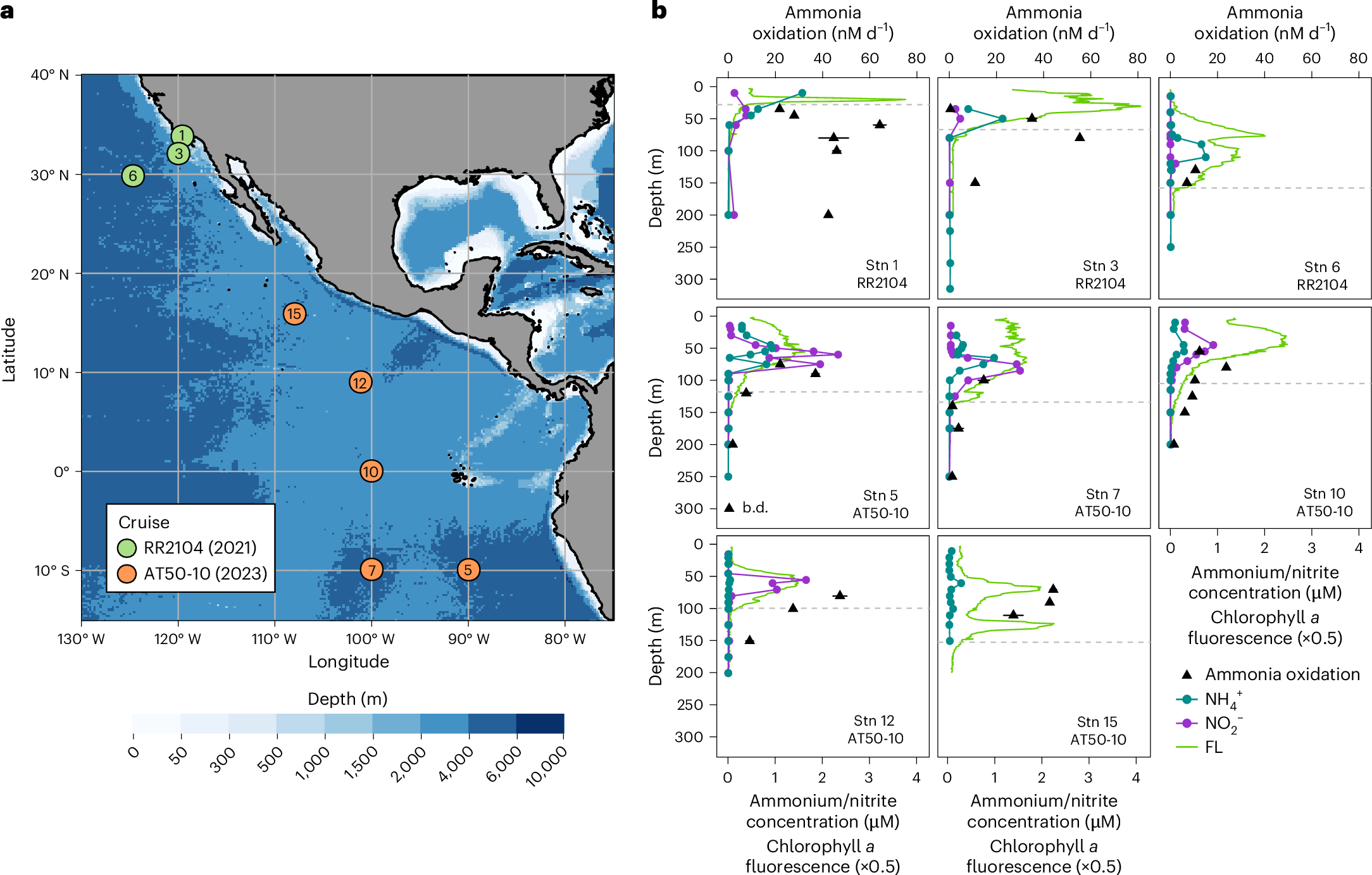
Ammonia-oxidizing archaea are the most abundant chemolithoautotrophs in the ocean and are assumed to dominate carbon fixation below the sunlit surface layer. However, the supply of reduced nitrogen delivered from the surface in sinking particulate organic matter is insufficient to support the amount of nitrification required to sustain measured carbon fixation rates in the dark ocean. Here we attempt to reconcile this observed discrepancy by quantifying the contribution of ammonia oxidizers to dark carbon fixation in the eastern tropical and subtropical Pacific Ocean. We used phenylacetylene—a specific inhibitor of the ammonia monooxygenase enzyme—to selectively inhibit ammonia oxidizers in samples collected throughout the water column (60–600 m depth). We show that, despite their high abundances, ammonia oxidizers contribute only a small fraction to dark carbon fixation, accounting for 4–25% of the total depth-integrated rates in the eastern tropical Pacific. The highest contributions were observed within the upper mesopelagic zone (120–175 m depth), where ammonia oxidation could account for ~50% of dark carbon fixation at some stations. Our results challenge the current view that carbon fixation in the dark ocean is primarily sustained by nitrification and suggest that other microbial metabolisms, including heterotrophy, might play a larger role than previously assumed.