2025-08-07 佐賀大学,東北大学,筑波大学九州大学,高エネルギー加速器研究機構, J-PARC センター
<関連情報>
- https://www.saga-u.ac.jp/koho/education/2025080738245
- https://advanced.onlinelibrary.wiley.com/doi/10.1002/advs.202509474
メカニカルルミネッセンス半導体Eu:SrAl2O4における超長距離磁気結合とフェロ磁性スピン凍結 Superlong-Range Magnetic Coupling and Ferromagnetic Spin Freezing in Mechanoluminescent Semiconductor Eu:SrAl2O4
Xu-Guang Zheng, Ichihiro Yamauchi, Tomasz Galica, Eiji Nishibori, Tatsuya Kawae, Jumpei G. Nakamura, Akihiro Koda, Chao-Nan Xu
Advanced Science Published: 31 July 2025
DOI:https://doi.org/10.1002/advs.202509474
Abstract
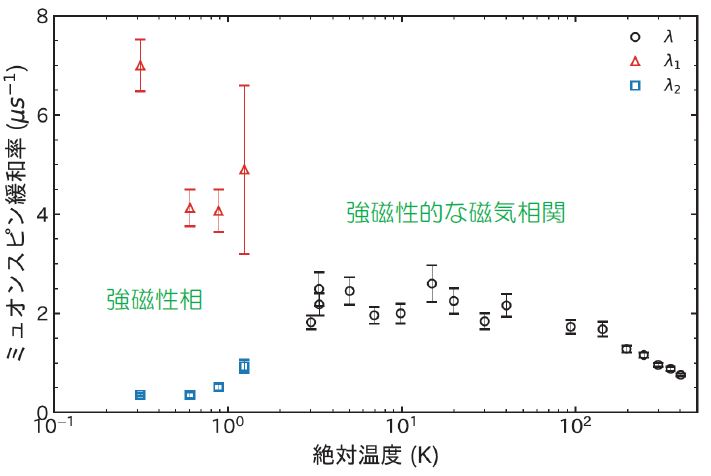
Magnetic transition in nonmetals requires the presence of a considerable proportion of magnetic spins. A new type of ferromagnet named dilute ferromagnetism that contradicts this well-established concept is proposed for semiconductors of ZnO etc. but has remained experimentally unproven. In this study, an unconventional superlong-range magnetic coupling and ferromagnetic spin freezing are reported, which can be viewed as an experimental realization of an intrinsic dilute ferromagnetism, in mechanoluminescent material of EuxSr1-xAl2O4 (x = 0.2−2%), wherein Eu is sparsely incorporated into the lattice to substitute Sr. Ferromagnetic coupling appears below ≈80 K and fully saturated ferromagnetic magnetization appears below ≈3 K, with an unusually large magnetic moment of ≈14 µB per Eu2+. Muon spin spectroscopy demonstrates intrinsic spin freezing with a spontaneous internal field developed below TC of ≈3 K. The neighboring magnetic Eu2+ ions in the lattice have an exceptionally large separation more than one order of magnitude larger than those in conventional magnets, marking it as a unconventional magnetic order over a superlong distance. Bound magnetic polarons arising from electrons trapped at oxygen vacancies may account for this unconventional ferromagnetism. Magnetization under light radiation supports this scenario.