2024-10-09 シンガポール国立大学(NUS)
<関連情報>
- https://news.nus.edu.sg/new-study-reveals-growing-weather-extremes-in-indo-pacific-region/
- https://www.nature.com/articles/s41561-024-01537-8https://www.nature.com/articles/s41561-024-01537-8
熱帯気象パターンの変化でインド太平洋地域の異常気象が深刻化 Indo-Pacific regional extremes aggravated by changes in tropical weather patterns
Chenyu Dong,Robin Noyelle,Gabriele Messori,Adriano Gualandi,Lucas Fery,Pascal Yiou,Mathieu Vrac,Fabio D’Andrea,Suzana J. Camargo,Erika Coppola,Gianpaolo Balsamo,Chen Chen,Davide Faranda & Gianmarco Mengaldo
Nature Geoscience Published:04 October 2024
DOI:https://doi.org/10.1038/s41561-024-01537-8
Abstract
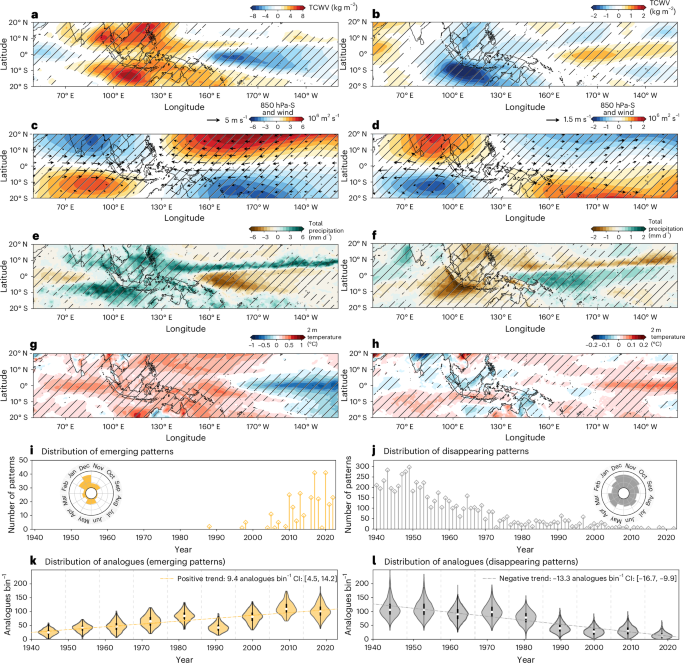
The Pacific Walker circulation and the closely connected El Niño/Southern Oscillation influence the climate and weather of the tropical Indo-Pacific region. They specifically exert a strong control on the regional occurrence of weather extremes, such as heatwaves, heavy precipitation and prolonged dry spells, which are becoming increasingly frequent and severe. However, climate models struggle to accurately simulate large-scale circulation changes in the tropics and thus their consequences for regional weather and future climate. Here we use high-resolution ERA5 reanalysis data from 1940 to 2022 to study the occurrence trends of weather patterns in the tropical Indo-Pacific region. We find that new large-scale synoptic situations that were rarely present before the 1990s have emerged in the Indo-Pacific, while some others that were prominent have disappeared. Those new synoptic situations are associated with an unusual proportion of heatwaves and extreme precipitation in the region. These weather patterns are physically consistent with a trend towards a stronger Pacific Walker circulation, wetter and warmer conditions in Southeast Asia and drier conditions in the equatorial Pacific. These changes cannot be fully explained by El Niño/Southern Oscillation and other relevant modes of interannual variability, and other factors such as global warming, aerosol forcing, external forcing mechanisms and nonlinear mode interactions may be contributing.