2026-11-19 サンディア国立研究所(SNL)
<関連情報>
幾何学的制約に対応した管内検査用コンプライアント六輪ロボットの設計
Design of a Compliant Six-Wheeled Robot for In-Pipe Inspection with Geometry Constraints
Daniel R. McArthur, Derya Z. Tansel, Clint Hobart, Josh Ortiz, Stephen P. Buerger
Robotics, 2026, 15(11), 210 Published:2026年10月22日
DOI:https://doi.org/10.3390/robotics15110210
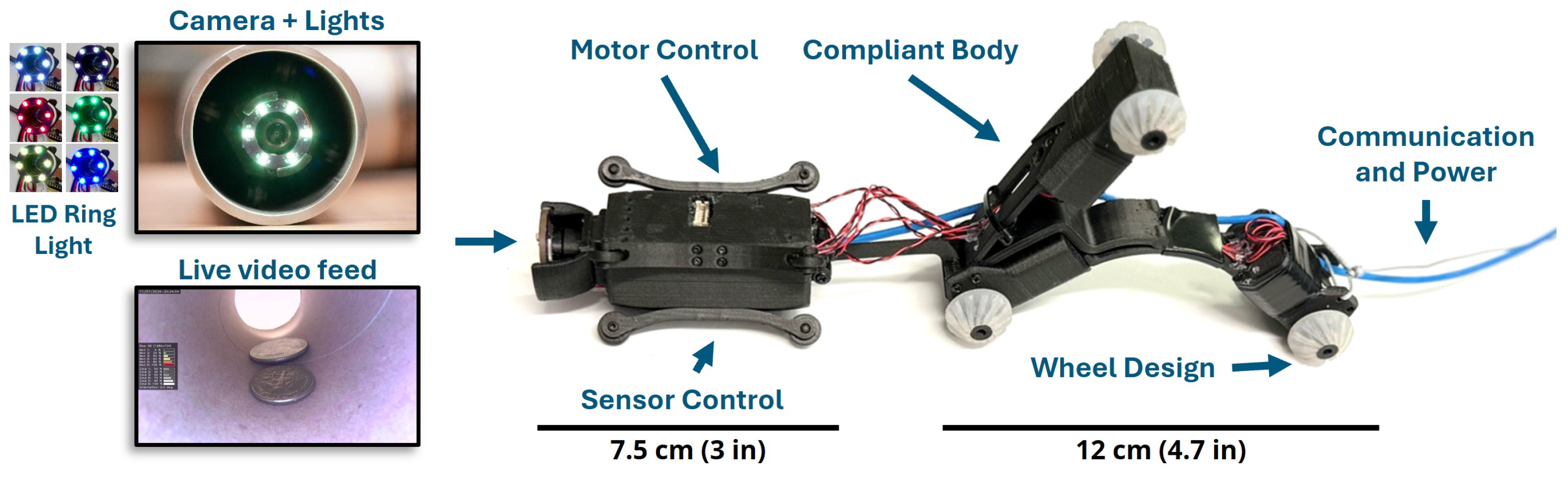
Figure 1. Self-Propelled Interior Inspector for NDT Examination (SPIINE) with flexible chassis for navigating tight bends with an onboard IMU, high-resolution video camera, and tether for power/data transmission.© 2026 by the authors. Licensee MDPI, Basel, Switzerland.Creative Commons CC BY 4.0
老朽化した水道管や産業用配管の内部を、掘削せずに検査するための小型六輪ロボット「SPIINE」が開発された。従来の管内検査ロボットは、小口径配管や急カーブへの対応、長距離走行、検査センサーの牽引力に課題があった。本研究のSPIINEは、車体に多軸方向へ変形できる柔軟な機構を組み込み、能動的な姿勢制御を行わずに配管形状へ受動的に適応する設計を採用した。内径53 mmの配管に対応し、曲率半径76 mmの90度エルボを通過できるほか、360度にわたる8種類の進入姿勢で前進・後退の通過試験に成功した。直線状の鋼管では最大16.5 Nの牽引力を発生し、ロボット重量の8倍を超える力で非破壊検査センサーなどを牽引できる。また、PVC配管を用いた試験では水平・垂直区間を含む60 m以上を走行し、代表的な走行条件で消費電力は約2~3.5 Wだった。さらに、車体の剛性と車輪の押付力を推定する解析モデルを構築し、実験値との比較で垂直反力の推定誤差はRMSE 0.21 N、牽引力の推定誤差は7~13%以内となった。本技術は、狭小配管の腐食や損傷を検査するロボットの小型化と長距離化に貢献する可能性がある。ただし、長距離試験はPVC配管で実施されており、鋼管での長距離性能や複数試作機による再現性の検証は今後の課題である。
This study presents SPIINE, a compact six-wheeled robot designed to inspect the interiors of aging water and industrial pipes without excavation. Conventional in-pipe inspection robots face challenges in navigating small-diameter pipes and tight bends, traveling long distances, and towing non-destructive testing (NDT) sensors. SPIINE incorporates a multi-axis compliant chassis that passively adapts to pipe geometry without requiring active steering or orientation control. It is designed for pipes with an inner diameter of 53 mm and can traverse 90° elbows with a curvature radius as small as 76 mm. Experiments demonstrated successful forward and reverse traversal at eight entry orientations spanning 360°. In straight steel pipe, the robot generated a maximum pull force of 16.5 N, more than eight times its own weight, enabling it to tow additional NDT sensor payloads. In a separate test using PVC pipe, it traveled more than 60 m through mixed horizontal and vertical sections, consuming approximately 2–3.5 W under representative operating conditions. The researchers also developed analytical models to estimate chassis stiffness and wheel normal forces. The estimated vertical reaction force achieved an RMSE of 0.21 N, while pull-force estimates were within 7–13% of measured values. The technology could contribute to compact, long-distance robotic inspection systems for detecting corrosion and structural damage in confined pipelines. However, long-distance performance in steel pipes and reproducibility across multiple prototypes remain subjects for future investigation.
原著論文:MDPI