2026-11-19 リンショーピング大学
<関連情報>
- https://liu.se/en/news-item/fridges-and-packaging-contribute-to-food-waste
- https://www.mdpi.com/2071-1050/18/17/8954
冷蔵庫内の食品包装は持続可能な食品消費を促進するのか、それとも妨げるのか?(Food Packaging in the Fridge: Helping or Hindering Sustainable Food Consumption?)
Babak Nemat, Renee Wever
Sustainability, Volume 18, Issue 17, Article 8954 (2026):2026-09-01
DOI:10.3390/su18178954
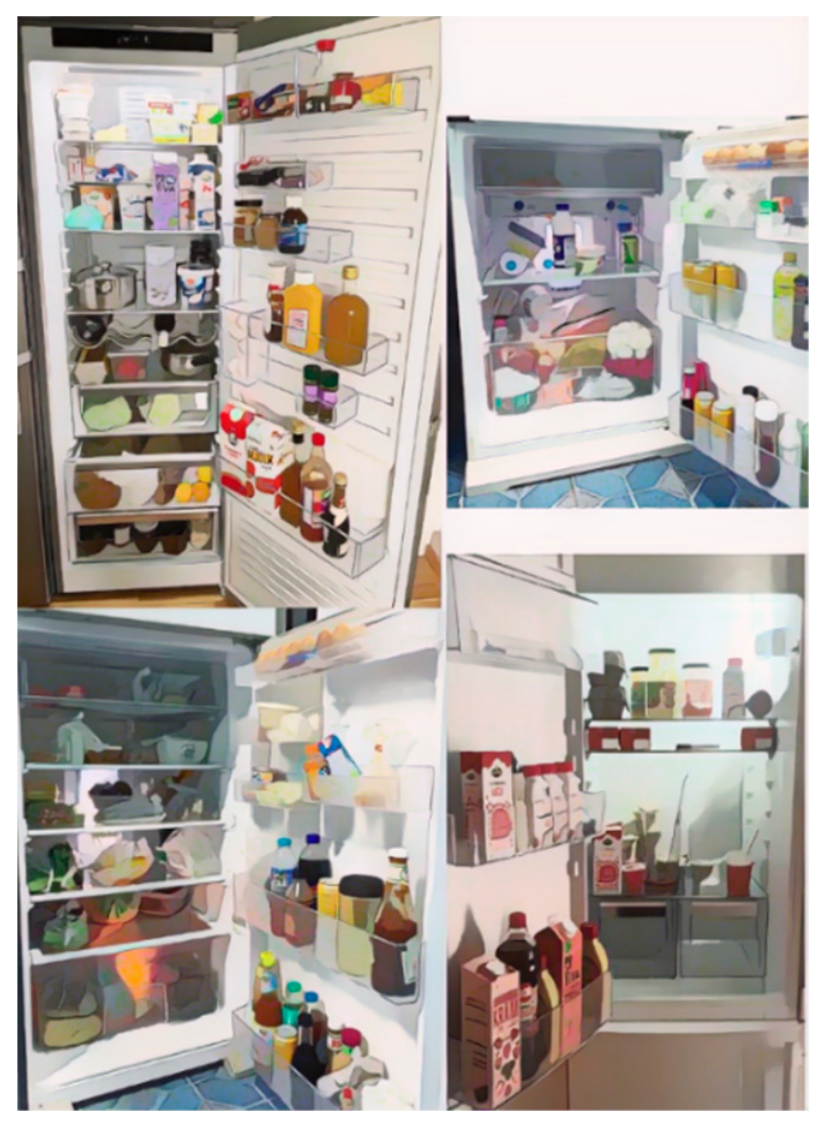
Figure 1 Sample illustrations based on participant-submitted refrigerator images, showing typical food organization patterns. The images have been stylized into cartoon form to protect participant privacy and to avoid unintended brand representation following the study’s ethical protocol. © 2026 by the authors. Licensee MDPI, Basel, Switzerland. This article is an open access article distributed under the terms and conditions of the Creative Commons Attribution (CC BY) license.
本研究は、家庭における食品廃棄の削減に向けて、人間の行動、冷蔵庫の使用環境、食品包装(HRP:Human practices, Refrigerator conditions, Packaging)の相互作用を統合的に分析した研究である。従来、食品廃棄は消費者行動や包装設計など個別の要因から検討されることが多かったが、本研究ではこれらを相互に影響する一体的なシステムとして捉えた。研究チームは、文献レビューに加え、スウェーデンを中心とする24世帯から提供された約47枚の冷蔵庫内部の写真を分析し、さらに12人を対象とした半構造化インタビューを実施した。写真を用いた分析では、食品の視認性、取り出しやすさ、収納配置、包装表示の確認しやすさなどを評価した。その結果、冷蔵庫への食品の過剰な詰め込みや不規則な収納によって食品が見えにくくなり、存在を忘れて廃棄される傾向が明らかになった。また、包装の透明性、再封性、表示機能などは、冷蔵庫の構造や収納方法との相性によって、その効果が十分に発揮されない場合がある。研究チームは、冷蔵庫を単なる食品保存設備ではなく、食品の認識や消費行動、廃棄を左右する重要な環境要因として位置付けた。本研究は、食品廃棄の削減には消費者への啓発だけでなく、冷蔵庫の使いやすさと食品包装の設計を一体的に改善することが重要であると示している。なお、本研究は探索的な質的研究であり、介入による食品廃棄削減量を定量的に実証したものではない。
This study investigates the interactions among human practices, refrigerator conditions, and food packaging (HRP) in relation to household food waste. Unlike previous studies that have often examined consumer behavior and packaging design separately, this research conceptualizes them as an interconnected system. The researchers combined a scoping literature review with qualitative fieldwork involving 24 households in Sweden and other countries. Approximately 47 refrigerator photographs were collected, and semi-structured interviews were conducted with 12 participants. Photo-based analysis examined food visibility, accessibility, spatial arrangement, and the visibility of packaging information. The findings revealed that overcrowded refrigerators and disorganized storage frequently make food difficult to see and access, increasing the likelihood that items are forgotten and eventually discarded. Furthermore, the effectiveness of packaging features, including transparency, resealability, and labeling, depends on their compatibility with refrigerator structures and household storage practices. The researchers emphasize that refrigerators should be understood not merely as food preservation appliances but as important contextual factors influencing food awareness, consumption, and disposal. The study suggests that reducing household food waste requires integrated improvements in consumer practices, refrigerator usability, and packaging design rather than relying solely on consumer education. As an exploratory qualitative study, however, it does not quantitatively demonstrate the amount of food waste reduction achievable through specific interventions.