2026-11-06 東北大学
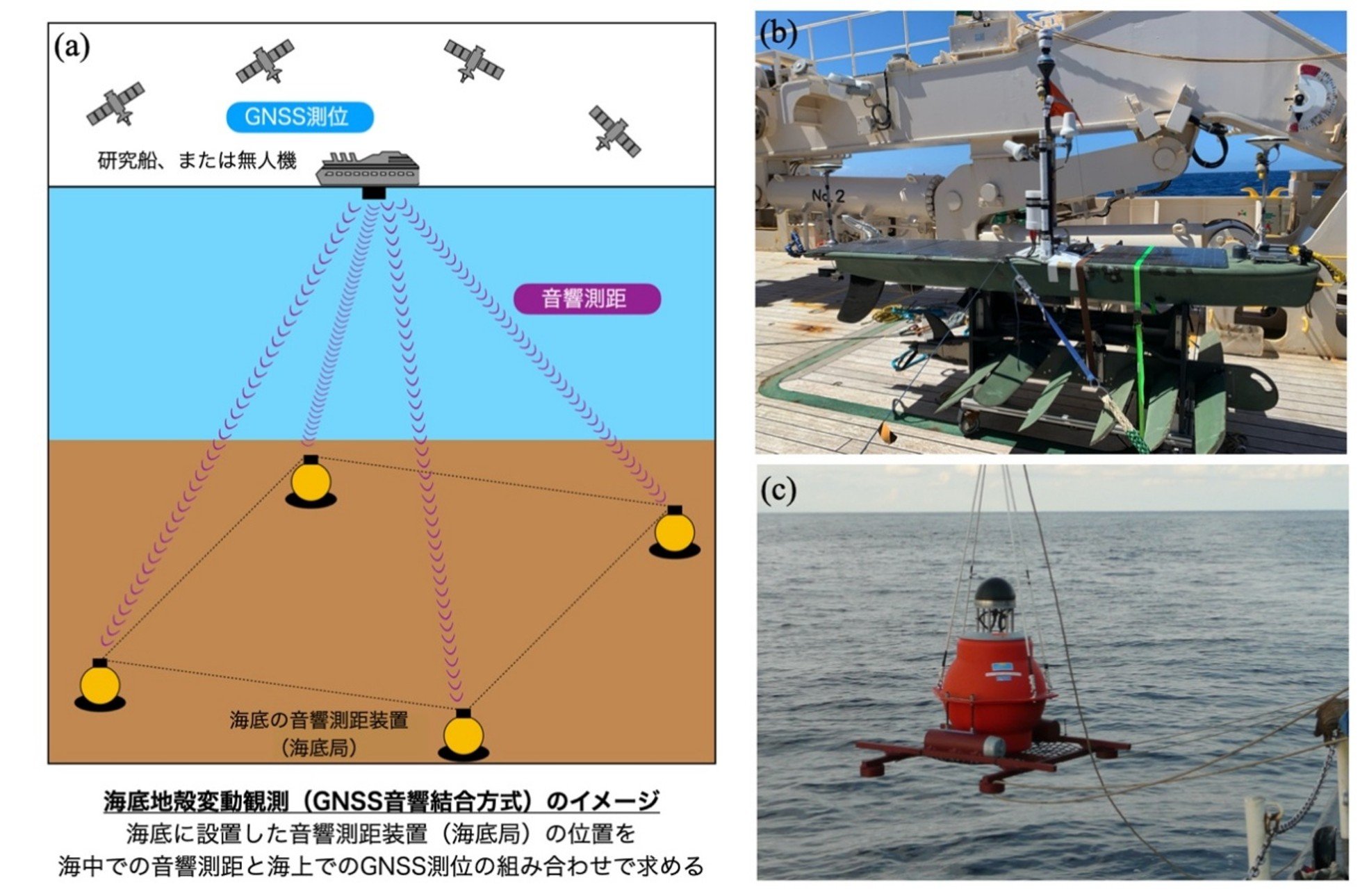
図1. 海底地殻変動観測(GNSS-A観測)による観測方式の概念図、および観測機器。(a)GNSS-A観測による観測方式の概念図、(b) GNSS-A観測に用いたウェーブグライダーの写真、(c)東北沖のGNSS-A観測点に設置した音響測距装置(海底局)の写真、をそれぞれ示す。
<関連情報>
- https://www.tohoku.ac.jp/japanese/2026/11/press20261106-01-relocking.html
- https://www.science.org/doi/10.1126/science.aeg7301
海底測地学により、2011年の東北地方太平洋沖地震後の巨大断層の再固着が急速に進行したことが明らかになった Seafloor geodesy delineates fast megathrust relocking after the giant 2011 Tohoku earthquake
Fumiaki Tomita, Tianhaozhe Sun, Motoyuki Kido, Takeshi Iinuma, Naoki Uchida, Yusaku Ohta, Ryota Hino, Jiangheng He, and Kelin Wang
Science Published:5 Nov 2026
DOI:https://doi.org/10.1126/science.aeg7301
Abstract
How and when the subduction megathrust recovers its locking state after a great earthquake is important to understanding earthquake-cycle physics and future hazards. Here we report the delineation of the relocking process after the 2011 magnitude 9 Tohoku earthquake with 14 years of postseismic seafloor geodetic observations. These data, combined with onshore geodetic observations, analyses of repeating earthquakes, and numerical modeling, reveal how the recovery of locking is interrupted by afterslip on the megathrust and accompanied by stress relaxation in the viscoelastic upper mantle. The results indicate that the megathrust has already arrived at a locking state today similar to that before the earthquake despite the ongoing stress relaxation. The acquired knowledge aids understanding of megathrust earthquake cycles at other subduction zones.