2026-10-20 合肥物質科学研究院(HFIPS)
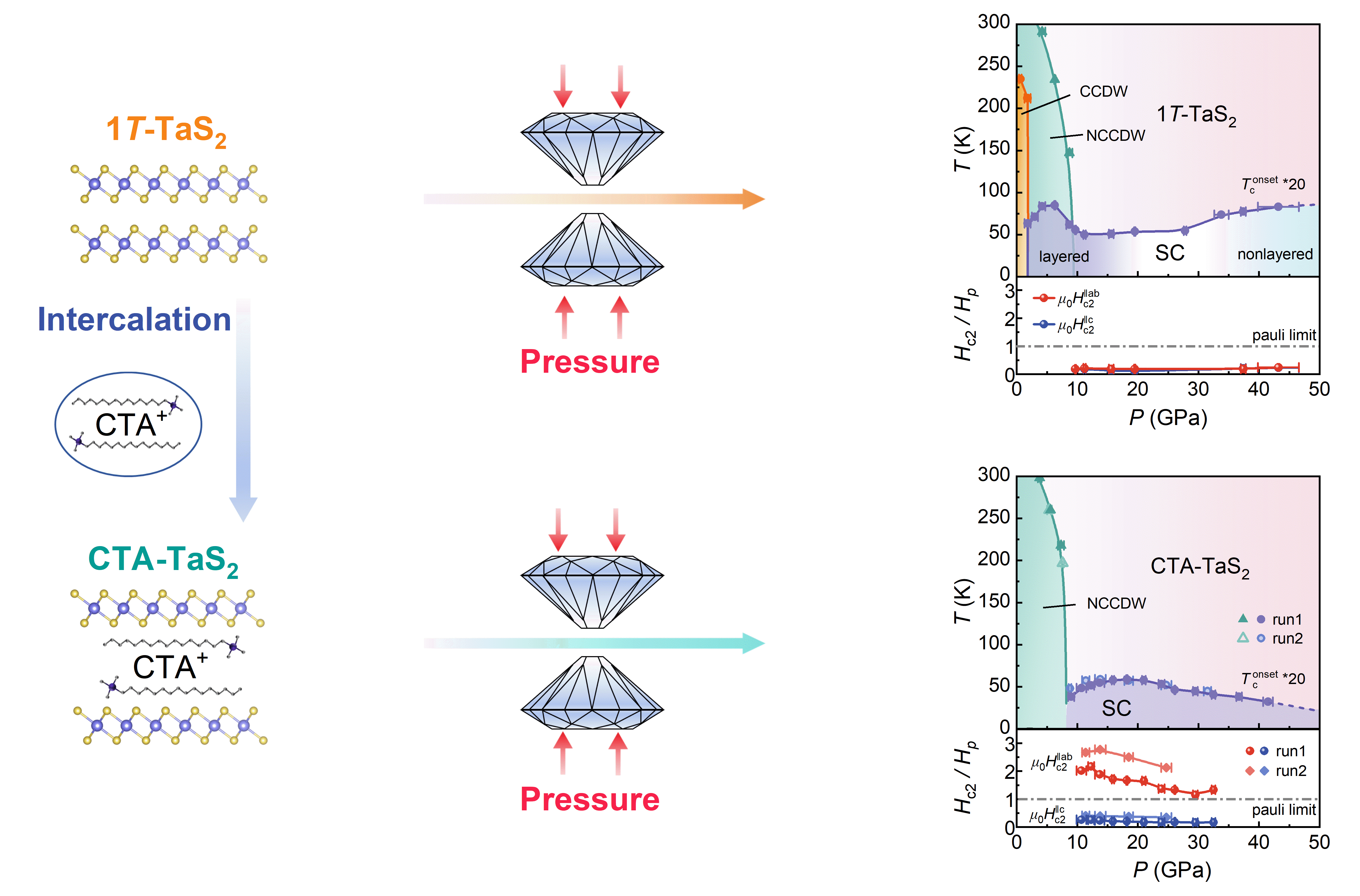
Schematic illustration of organic intercalation in 1T-TaS2 and its high-pressure phase diagram. (Image by Chen Jiaqi)
<関連情報>
- https://english.hf.cas.cn/nr/rn/202610/t20261020_1208629.html
- https://iopscience.iop.org/article/10.1088/1361-6633/aea4f0
有機物層間挿入型1T -TaS2における圧力誘起イジング超伝導 Pressure-induced Ising superconductivity in organic-intercalated 1T-TaS2
Jiaqi Chen, Shuyang Wang, Lixuan Yu, Xuliang Chen, Chao An, Yonghui Zhou, Yilin Wang and Zhaorong Yang
Reports on Progress in Physics Published: 21 September 2026
DOI:10.1088/1361-6633/aea4f0
Abstract
Layered transition metal dichalcogenides host a rich landscape of correlated electronic phases that are profoundly sensitive to interlayer coupling. Although both thinning and pressure have been individually used to tune these properties, the high-pressure behavior of low-dimensional systems remains largely unexplored. Here, we propose a synergistic tuning strategy by combination of organic cation intercalation and pressure to simulate the properties of low-dimensional materials under pressure. We show that intercalating cetyltrimethylammonium cations into the bulk 1T-TaS2 significantly weakens the interlayer coupling and leads to an effective reduction in dimensionality. Moreover, the intercalated sample exhibits distinct features under high pressure as compared with non-intercalated one. The superconductivity in the intercalated sample is induced accompanied by a complete suppression of nearly commensurate charge density wave order, differing from the melting of commensurate state in the non-intercalated case. Upon further compression up to 58.1 GPa, the superconductivity displays a dome-shaped evolution, also without showing re-enhancement that presented in the non-intercalated sample. More strikingly, the superconductivity in the intercalated 1T-TaS2 displays signatures of Ising superconductivity, with its in-plane upper critical field exceeding twice the Pauli paramagnetic limit. Our findings not only provide a powerful route for tuning the collective electronic states but also open up possibilities in searching for emergent phenomena in low-dimensional materials.