2026-11-11 東北大学
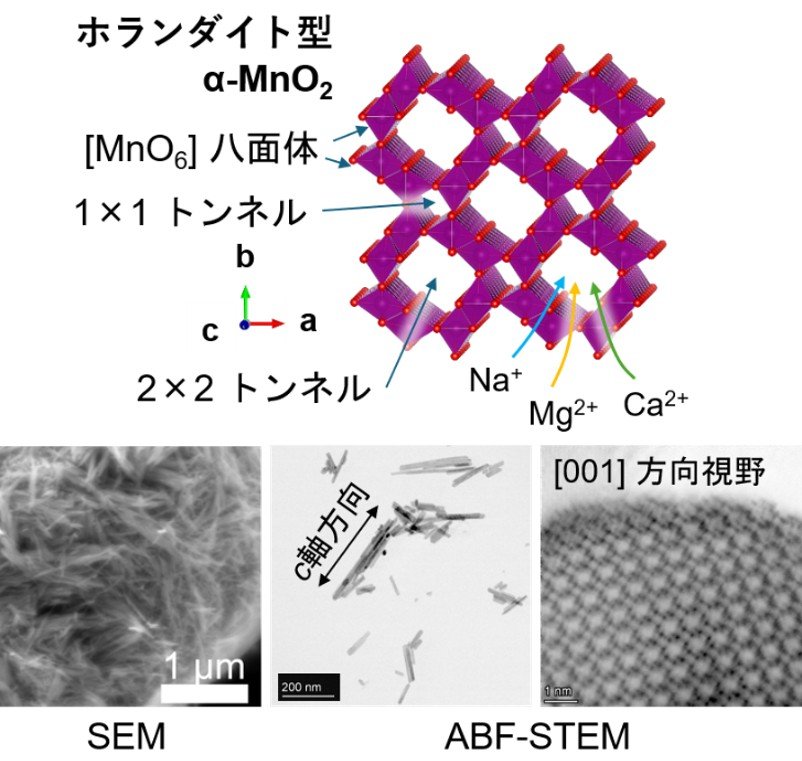
図1. ホランダイト型α-MnO2の結晶構造と合成粒子の走査型電子顕微鏡(SEM)と環状明視野走査透過電子顕微鏡(ABF-STEM)画像
<関連情報>
- https://www.tohoku.ac.jp/japanese/2026/11/press20261111-05-ion.html
- https://pubs.acs.org/cmatex/article/doi/10.1021/acs.chemmater.6c02510/5463854/Atomic-Scale-Origin-of-Spatially-Heterogeneous
ホランダイト型MnO2 における空間的に不均一な挿入の原子スケール起源 Atomic-Scale Origin of Spatially Heterogeneous Insertion in Hollandite-Type MnO2
Hongyi Li; Yue Qi; Shusuke Fukui; Yuichiro Hayasaka; Xiatong Ye; Kakeru Kobayashi; Tomoya Kawaguchi; Tetsu Ichitsubo
Chemistry of Materials Published:November 04, 2026
DOI:https://doi.org/10.1021/acs.chemmater.6c02510
Abstract
Hollandite-type α-MnO2 is a prototypical tunnel-structured host for rechargeable batteries, yet the atomic-scale mechanisms governing multivalent-ion insertion remain poorly understood. Here, we reveal how guest-ion species dictate electrochemical reaction pathways through distinct occupation modes within the one-dimensional tunnels of α-MnO2. By combining electrochemical analyses, atomic-resolution scanning transmission electron microscopy, and soft X-ray absorption spectroscopy, we directly correlate reaction kinetics with guest-ion configurations and the accompanying structural and electronic responses of the host framework. Electrochemical measurements reveal substantial diffusion-controlled contributions for both Na+ and Mg2+, whereas Ca2+ exhibits predominantly surface-controlled behavior. Atomic-resolution imaging demonstrates that, despite their comparable macroscopic kinetic contributions, Na+ and Mg2+ exhibit distinctly different microscopic insertion modes: Na+ homogeneously occupies the tunnel-center sites throughout the particles, whereas Mg2+ occupies both tunnel-center and off-center sites, with pronounced near-surface enrichment accompanied by local tunnel distortion. In contrast, the Ca2+ reaction is largely confined to the near-surface region, with no clearly detectable occupation of the internal tunnel sites. Soft X-ray absorption spectroscopy further reveals spatially heterogeneous Mn reduction, with more pronounced reduction near the structurally less constrained particle surface. These results establish a direct relationship between guest-ion occupation modes, electrochemical reaction pathways, and the resulting structural evolution, providing an atomic-scale design principle for engineering tunnel-type host materials for multivalent-ion insertion.